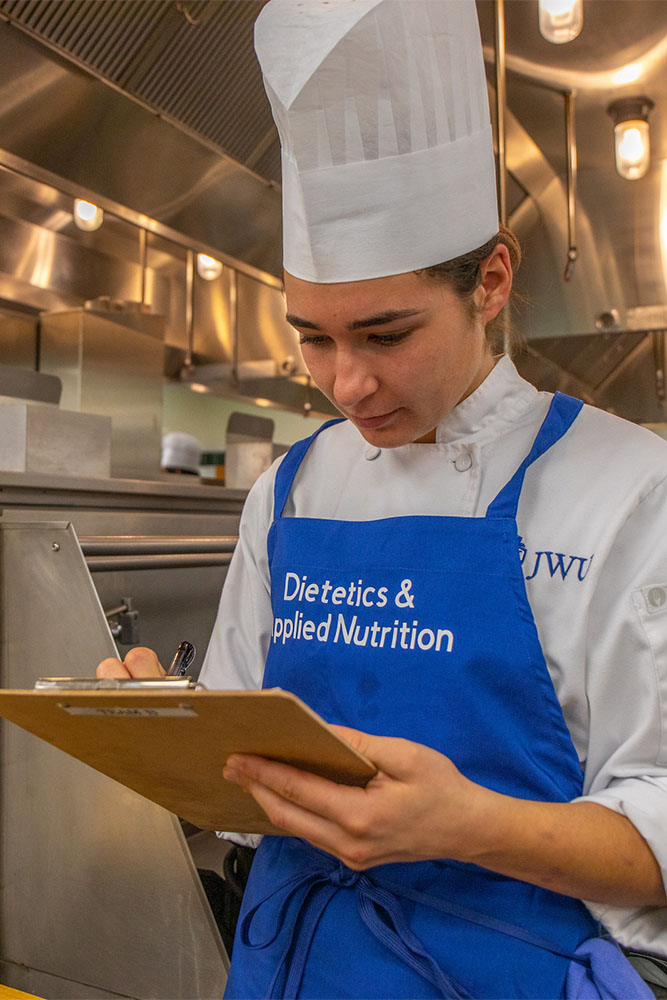
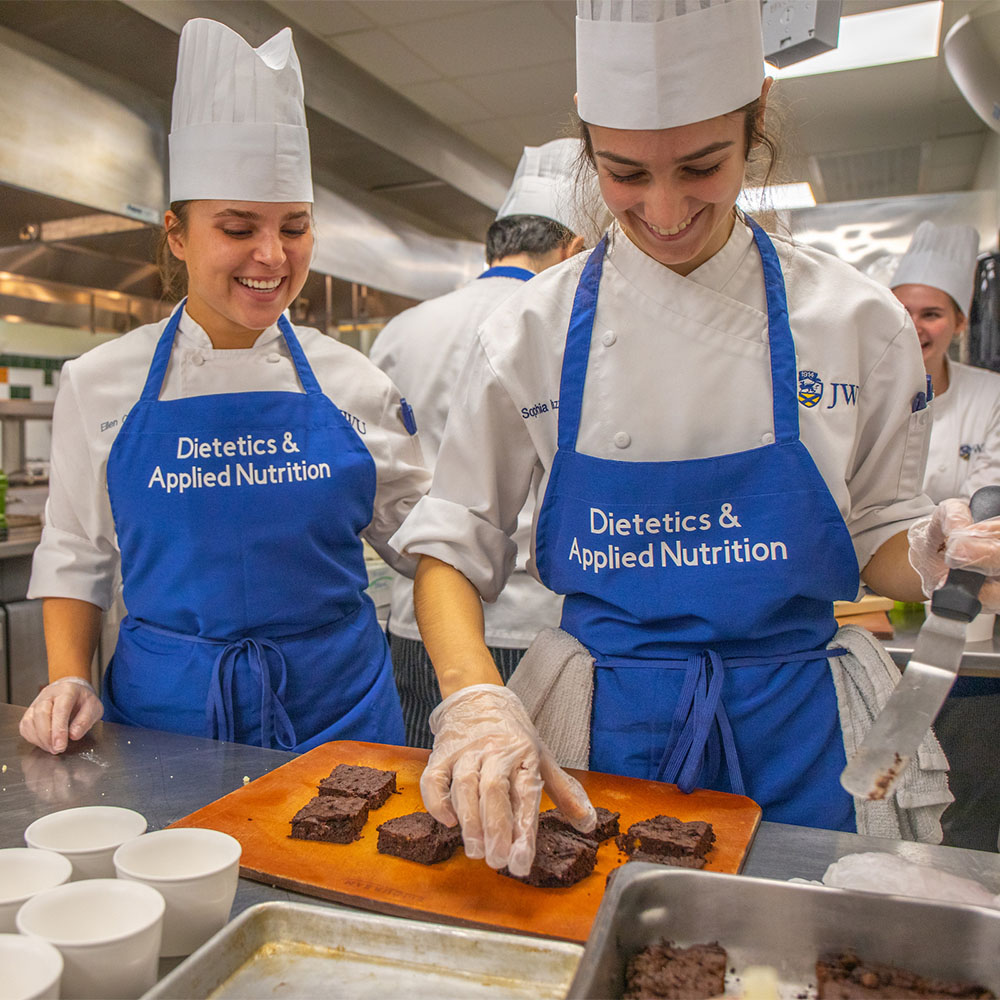
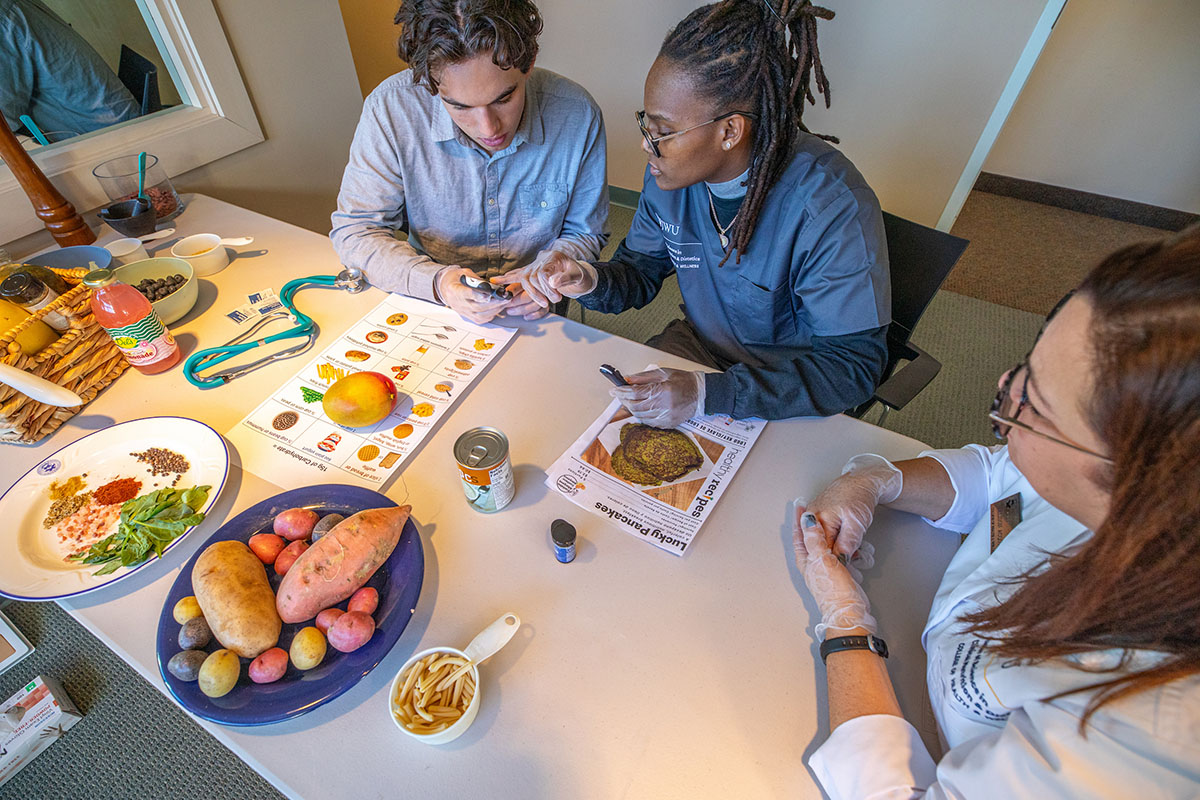
What’s the connection between food, nutrition and health? What does it take to identify nutrition-related problems? How do we find solutions? JWU’s Bachelor of Science in Dietetics and Applied Nutrition (DiAN) degree explores these questions and more, preparing you for the path to becoming a registered dietitian nutritionist (RDN).
You’ll focus on subjects ranging from nutrition science, culinary fundamentals and food service systems management. By taking classes such as microbiology, chemistry and human physiology, you’ll deepen your understanding of nutrition principles. Your JWU education will prepare you to identify and diagnose nutrition problems, develop nutrition care plans and execute therapeutic menus.
Your coursework in this major satisfies the official academic standards of a Didactic Program in Dietetics (DPD), which is accredited by the Accreditation Council for Education in Nutrition and Dietetics (ACEND).
Admission is contingent upon meeting the technical standards for this program.
Powered by Purpose
“My purpose is to impact the health of others through the way I know best — and that’s food.”
In this video, Nina Palmer ’22 discusses why she chose to earn JWU’s Dietetics and Applied Nutrition degree.
Didactic Program in Dietetics (DPD) Advantages
Our unique Didactic Program in Dietetics (DPD) program combines nutrition science with a culinary arts foundation.
JWU’s program provides the academic framework to prepare students for graduate school* and supervised practice, leading to eligibility for the CDR credentialing exam to become an RDN.** Learn more about JWU’s M.S. in Clinical Nutrition & Dietetics (MSCND).
*Effective January 1, 2024, the Commission on Dietetic Registration (CDR) requires a minimum of a master’s degree to be eligible to take the credentialing exam to become a registered dietitian nutritionist (RDN). **Individual states may require specific licensing or professional certification in addition to earning a degree in order to practice in the field. Learn more via the JWU Catalog’s Licensure & Professional Certification Disclosures.
Career Options
Some professions may require additional study, background checks, certifications, licenses, exams and/or experience as required qualifications for employment. Students are responsible for verifying that they can meet the employment requirements of potential employers.
In 2025, Dietetics & Applied Nutrition Instructor Michelle Pearson, RDN, LDN, received the Rhode Island Academy of Nutrition and Dietetics’s Courtney Huard Compassion Award, which recognizes dietetics professionals who demonstrate passion for their field through a genuine interest in the clients or population they serve.
“I felt honored and grateful to be recognized,” said Pearson of her achievement. “Many RDNs are committed to providing the highest quality care to their patients.”
Your Dietetics and Applied Nutrition degree builds upon a foundation of culinary arts courses that provide you with a unique skillset integrating culinary skills and nutrition knowledge. The foundational culinary courses in your first two years provide you with culinary expertise and techniques, leadership in the kitchen and other essential skills.
9 credits selected from 1000-4999 numbered offerings within the university
9
Total Credits
120.0
The Dietetics and Applied Nutrition program is accredited by the Accreditation Council for Education in Nutrition and Dietetics (ACEND).
Accreditation Council for Education in Nutrition and Dietetics 120 South Riverside Plaza, Suite 2190 Chicago, IL 60606-6995 ACEND@eatright.org 800-877-1600 Ext. 5400 Eatrightpro.org/acend
Accreditation Status: Accredited Date of Initial Accreditation: 6/1/2000 Accreditation Term Ends: 6/30/2030
Information for Graduates of the Denver Culinary Nutrition DPD
Graduates of the JWU Denver’s Culinary Nutrition program, which was taught out at the now-closed Denver Campus, should contact the department by email with any questions related to program records, Verification Statement eligibility and processing, and eligibility to pursue supervised practice and/or to sit for credentialing examinations.
Dietetics and Applied Nutrition students take courses in nutrition and foundational sciences and are able to enhance their skillset with a unique culinary arts education. Our graduates truly understand the connection between nutrition science and food.”
Maeve Guidera, director of the Dietetics and Applied Nutrition program