You Had to Be There
Consumers are increasingly investing in experiences and JWU graduates are stewarding their not-to-be-missed moments.
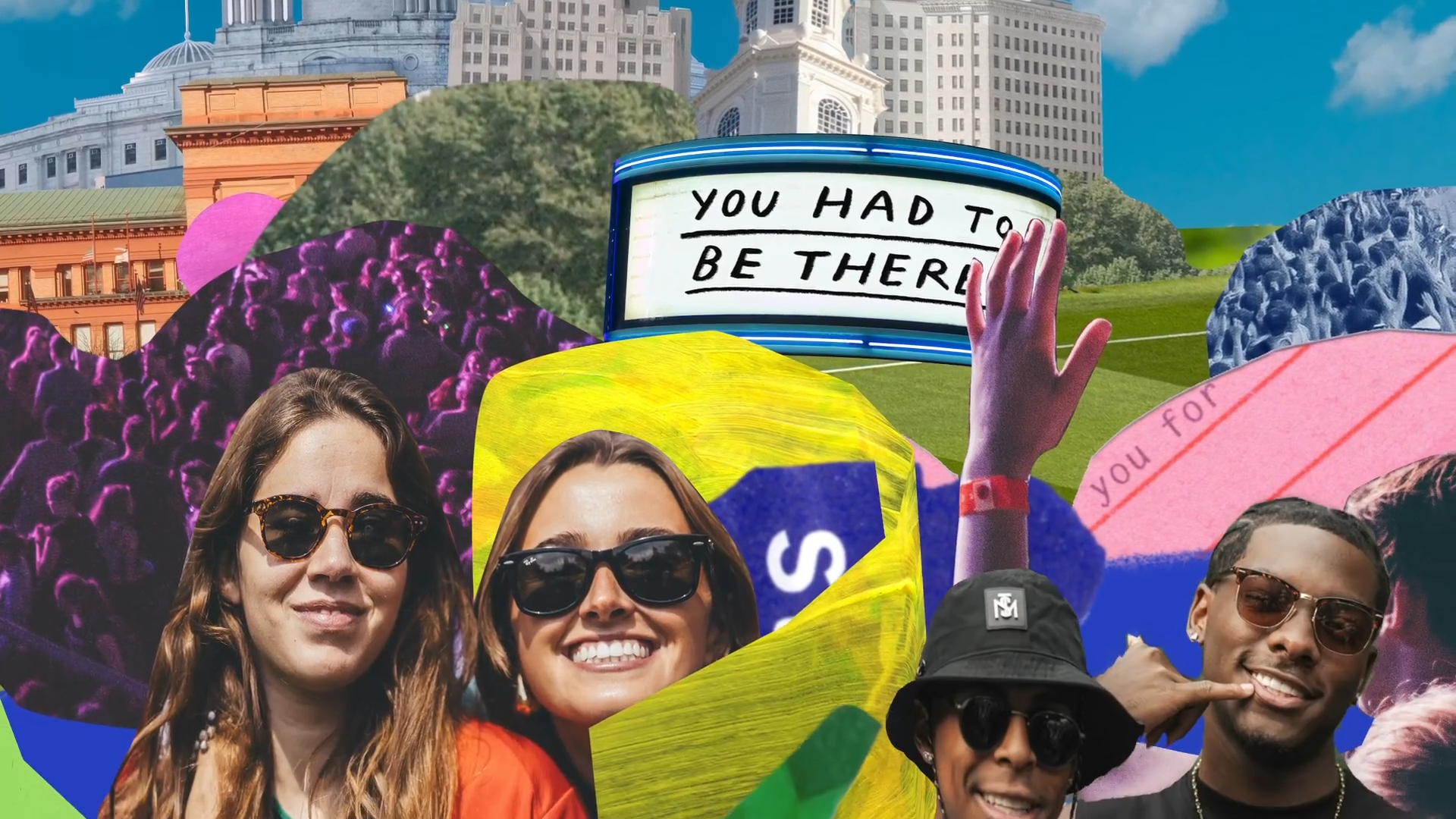
In June, in the heart of downtown Providence, people from across the world erupted in unison as goals flashed across a jumbotron at watch parties for the ’26 FIFA World Cup. The PVD FanZone, set up on the lush green of Station Park, welcomed more than 145,000 visitors who arrived draped in a rainbow of team regalia. With the State Capitol Building and waving international flags as the backdrop, teens played lawn games, children enjoyed facepainting and crowds spilled into nearby restaurants and businesses.
An event of this size, scale, and success—while appearing seamless to guests—does not happen without a lot of strategy, planning and expertise behind the scenes and JWU graduates are leading the charge in creating unforgettable, you-just-had-to-be-there moments. One example is Jonathan Walker, ‘14, ‘18, Executive Director of the Rhode Island Sports Commission at GoProvidence, whose work helped Rhode Island prepare for and capitalize on the opportunities surrounding the 2026 FIFA World Cup. While the PVD FanZone was led by the Providence Department of Art, Culture, and Tourism and the Providence Tourism Council, Walker and the Rhode Island Sports Commission played a significant role in the broader RI Summer of Soccer initiative, helping create a destination-wide experience around the tournament while also positioning Rhode Island to host one of the participating national teams.
“Today’s experience economy is about making memories over material things,” says Walker, who graduated from the Sports, Entertainment, Event—Management (SEEM) program and later received his online MBA with a concentration in hospitality, both from JWU. Other hospitality degrees include Hospitality Management and Food & Beverage Industry Management.
The explosion of the experience economy
The PVD FanZone is one illustration of the rise in demand for immersive, authentic live events that prioritize memories over objects. While entrance to the PVD FanZone cost nothing (a rarity in a world where big stadium concert tickets can average $216), the experience economy is big business. Consumer spending on recreation services totaled approximately $819.2 billion in 2025 according to the U.S. Bureau of Economic Analysis, reflecting a significant post-pandemic rise in spending on entertainment, membership clubs, sports centers and related leisure activities.
Today’s experience economy is about making memories over material things.
-Jonathan Walker, ’14, ’18 MBA.
“We’re in a ‘you-had-to-be-there moment’,” says Elizabeth Craighead ’09, Vice President of Experiential at Live Nation, the world’s leading live entertainment company. “Consumers want to prioritize live experiences that you can’t replicate. We throw around terms like ‘once in a lifetime’, and ‘money can’t buy,’ but there’s a lot of truth to that. People want to be immersed in these moments. This is especially true after COVID when the demand for experiences exploded.”
Marina Middleton ’13, the CEO and Co-owner of Create & Cultivate, an events and media company, agreed that the experience economy came back heavily after COVID. “I think people were just like, ‘I need this’ after being cooped up for so long. In addition to the post-pandemic effect, I think individuals are increasingly burnt out by their online lives. We’ve gotten to the point where people are trying to just be together, get a hug, have a real conversation.”
Deloitte calls consumers’ post-pandemic willingness to pay a premium for live entertainment and experiences — even while the cost of living and inflation is rising — the effect of “funflation,” and it doesn’t appear to be dampening. In 2024, Deloitte surveyed approximately 3,500 Americans for its Digital Media Trends study and found the majority (61%) invested in at least one live event in the last six months. The average attendee surveyed went to seven live events in the past six months. And those in younger generations, particularly Gen Zs and millennials, were the most likely to seek out multiple and diverse live events.
Associate Professor Elizabeth Covino, who teaches event management courses within the SEEM program, points to Taylor Swift’s The Eras Tour as one of the most “impressive and clear” examples of the power of the experience economy. With more than 10 million attendees worldwide, Swift didn’t just deliver a 51-city concert tour, she created what The Washington Post called a “cultural phenomenon” that inspired some fans to fly internationally or pay a premium multiple times over to experience it.
Covino discussed the immersive culture, special details, and authentic vibe that Swift built to make her tour successful. She says, “Swift illustrated that it wasn’t enough to just attend the concert; you had to experience it. Attendees brought friendship bracelets to trade, wore special outfits to match the theme of Swift’s performance and the crowds of thousands became part of the concert’s light show.”
The creation of an immersive world helped make The Eras Tour the highest grossing tour of all time with an estimated profit of $2.2 billion.
It’s harder (and more rewarding) than it looks
For fans, Swift made the Eras Tour look effortless. The reality is that it took a massive international team, from sound technicians to truck drivers, all working towards a single goal to create the once-in-a-lifetime experience described by fans. JWU graduates across the globe are also doing that detail-oriented work to create unforgettable moments — and sharing in the rewards of the memories they make.
“We do a lot to make our events look easy and flawless,” notes Craighead, whose experiential team manages anything with a live component for brand partnerships, including creating VIP experiences at music festivals like Lollapalooza and BottleRock or executing a post-conference party from beginning to end. “It’s about paying close attention to a lot of details; having plans A, B, and C.” For example, inclement weather at Chicago’s Lollapalooza festival recently gave her team a run for its money, but they were ready. She says that type of snafu is a perfect example of why you must “expect the unexpected” and plan for every possibility when creating experiences.
But the payoff can feel transcendent.
“Most of us live for the moment that the band or artist goes on stage. People eat it up. They start singing, dancing, jumping. It’s this unified force that you can palpably feel, and we all take a deep breath because we made something special happen for people,” says Craighead, who also graduated from the SEEM program and whose team handles 150 programs globally annually.
Most of us live for the moment that the band or artist goes on stage … It’s this unified force that you can palpably feel.
Craighead’s whole business is creating “customized and curated” experiences for her brand partners, which can include things like backstage tours, photo opportunities with artists or decked-out suites on-site. Delivering the unforgettable means truly knowing who you’re doing it for and why, she says. “To create something special, you have to know your audience inside and out because everything doesn’t work for everyone,” she explains.
Craighead, who prior to joining Live Nation worked on NYC PRIDE and toured with Demi Lovato activating a pre-concert sponsorship experience for Tampax, encouraged students to approach the work as “a non-ego game” and stressed the importance of flexibility in the evolving world of experiential hospitality.
She explains, “In this work, you have to be flexible because you have to roll with whatever a client might ask, what an artist might need or what the environment is telling you. My cardinal rule is ‘underpromise but always overdeliver’.”
The power of building connection
Middleton, who earned her BS in marketing, also knows a thing or two about bringing massive immersive experiences to large crowds. Her team recently hosted its second Create & Cultivate Festival, the largest festival for women in business, in Los Angeles.
The scope of the festival was immense with a venue the size of five football fields filled with four live stages to host 150+ speakers who spoke to thousands of businesswomen. Keynotes included influencer and podcaster Alix Earle and businesswoman Emma Grede (co-founder of Good American and founding partner of Skims). Beyond the stages, attendees had access to more than 300 experiential brand activations, multiple workshops and countless networking opportunities. The event closed with a musical performance from Cardi B, no less.
“Nothing on this scale has ever existed for women in business before,” says Middleton, who bought Create & Cultivate in 2023 after having been an attendee of its events, a guest speaker, and then, an investor. While Create & Cultivate hosted smaller events before Middleton’s tenure, the festival was her brainchild, and the payoff has been tremendous. She explains, “The festival itself is the largest thing that we’ve ever created. Between our festival and other events, we reach over 3 million women, and we have an email list of 500,000 subscribers.”
For Middleton, success has meant balancing excellent event execution with the prioritization of human connection. She says, “What people often get wrong in the experiential space is they’re focused so much on what’s happening versus how you can engineer connection between people. Building those connections is what we do.” At last year’s festival, Middleton’s team facilitated over 10,000 one-on-one meetings, she says.
That focus on connection doesn’t stop with attendees; it also shapes how Middleton’s team brings brands into the experience.
“You’re never going to walk into a sponsor activation at a Create & Cultivate event and get handed a business card. You’re just not. And not because those don’t work, but they don’t work at our events. What we want is for people to connect with one another authentically, to try out the products, do the demos, and be in the experience. For example, we do coffee shops in the pop-ups. There might be a DJ, tattoos, tooth gems. It’s very experiential. We want people to say, ‘I love this brand’.”
That approach means that Create & Cultivate events might look different from the business networking events people are used to. There are no folding tables or linens. No step-and-repeat branded photo backdrops. No generic exhibitor booths, Middleton says.
“We create beautiful, unique events and because of that, women love being there,” she said.
That approach has led to millions of loyal experience economy customers.
The importance of looking ahead
Sometimes the deep preparation required to execute an extraordinary experience can take months like the Create & Cultivate festival; other times, it’s years in the making. For Walker, the work surrounding the RI Summer of Soccer, which comprised over 100 community events including the PVD FanZone, began four years before the first FIFA World Cup match was played in the region.
When Boston was named a World Cup 2026 site in 2022, Walker’s wheels started turning right away. With Providence just 50 miles from Boston and about 20 miles from Gillette Stadium, he saw a once-in-a-lifetime opportunity to make Rhode Island a major player in the international experience — creating memorable moments for fans and would-be fans while positioning the state as an attractive home base where visitors could stay, dine and experience local culture.
“It was gratifying to see Rhode Island come together around such a unique opportunity,” says Walker. “Whether it was helping welcome an international team to the state, creating opportunities for local youth to connect with the World Cup experience, supporting transportation options for visitors traveling to matches or helping create a championship-style atmosphere throughout Rhode Island, the goal was to make sure people could experience something special here.”
To create something special, you have to know your audience inside and out because everything doesn’t work for everyone.
-Elizabeth Craighead ’09
Walker adds, “By creating those memorable moments, we were able to give both visitors and Rhode Islanders an opportunity to experience the destination in a new way while also creating economic and community benefits that could extend beyond the tournament itself.”
Currently, Walker and the Rhode Island Sports Commission are pursuing bids for large-scale sporting events that wouldn’t take place for another five or six years.
What we want is for people to connect with one antoher authentically .. and be in the experience
-Marina Middleton ’13
He recommends that those who want a career in the experience economy stay “tapped in” to the ever-changing landscape.
“You need to have a vision for events and experiences that may not occur for many years. You need to know the key players in the industry, the market conditions, where things are trending, and, just as importantly, what attendees are looking for and how they want to experience an event,” says Walker, who credits JWU faculty and their decades of real-world experience in hospitality end event management with instilling in him the importance of understanding those factors.
He added, “My experiential education at JWU is the reason I’m in my position. If I hadn’t had the opportunity to work directly in sports as a student, I wouldn’t have had the confidence … and I wouldn’t have been aware of the different career paths and opportunities in the world of sports outside of actually playing.”
An education that understands the evolution of hospitality
Through hands-on projects, industry partnerships and real-world learning, students aren’t just studying hospitality at JWU, they’re practicing the collaboration, creativity and adaptability needed for today’s experience economy and building networks of invaluable career connections.
“As part of the SEEM program curriculum we realize that to understand events, students must go out into the industry and put learning into practice through real-life experiences and projects,” explains Covino, who notes that the program provides a litany of opportunities for students to apply their coursework to the real world, including the annual SEEM Concert.
The SEEM concert is the result of months of student-led planning, collaboration and problem-solving, guided by Covino. What begins as an idea in the Advanced Event Production: Concert course becomes a full-scale event where every decision, from booking talent to securing a venue, has real impact.
As part of the SEEM program curriculum we realize that to understand events, students must go out into the industry and put learning into practice through real-life experiences and projects.
-Elizabeth Covino
From the start, students are immersed in the realities of the industry, an approach Covino intentionally built into the course. “In the first semester, we learn about concert production, and in the second semester, the class produces the event,” she explained.
That event, JWU Jam Fest, was not handed to the students; it grew from their own ideas and collaboration. “It was an idea that came up during class, and we all loved it,” says Megan Correia ’27. The goal was to create an exciting, memorable experience for the campus community. The concert offered a range of attractions, including live entertainment, local vendors and food trucks.
By the time JWU Jam Fest took place, it represented more than an afternoon of music. For the students behind it, the concert was a culmination of what they had learned and a chance to apply their skills in a real-world setting.
The newly integrated College of Hospitality & Business, which houses the SEEM program, also provides ongoing opportunities to hear from experts. Both Walker and Craighead have returned to campus to share their hard-earned wisdom.
At a 2024 Conference, Walker advised students to appreciate all that a JWU education has to offer. “Embrace the assets that you have here at JWU,” said Walker. “Not only your fellow students, but the faculty — their level of industry experience and knowledge are unmatched. I think sometimes students are afraid to take advantage of that, ask questions or stick around after class, but I would say use the network you have here and all the assets that you have on campus and take full advantage of your education.”