
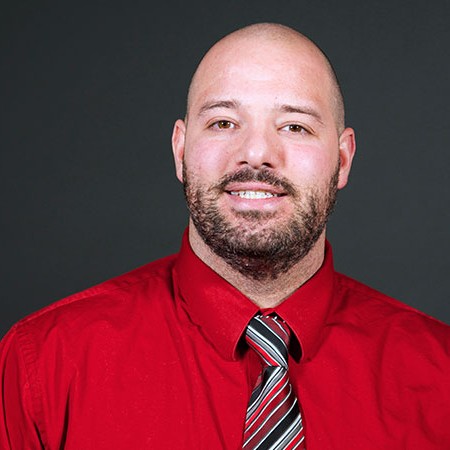
Christos S Dimos (he/him)
Professor College of Arts & Sciences Department of Biological and Physical Sciences Providence
Biography
Christos Dimos has always been fascinated with micro- and molecular biology. As an undergraduate at Sacred Heart University, he studied the role that the HS8A gene played in stress response in a soil amoeba called Dictyostelium discodeum. His Ph.D. research at the University of Rhode Island focused on discovering the function of the Cellulose Synthase-Like D (CSLDs) gene family in the moss Physcomitrella patens by performing targeted gene knockout, RNAi global silencing, and RT-qPCR studies. He also completed a comprehensive polysaccharide labeling study using various monoclonal antibodies and Carbohydrate Binding Modules (CBMs). Dimos is currently developing undergraduate research projects focused on plant-pathogen interactions using the moss P. patens
Dimos has been teaching at JWU for the last sixteen years and has professional interest in the field of teaching and learning. Currently, he is investigating the self-directed learning characteristics of students enrolled in STEM majors.
Education
PhD, University of Rhode Island
Biological Sciences
BS, Sacred Heart University
Biology
Adult Higher Education Alliance
Adult Higher Education Alliance
International Society for Self-Directed Learning
Adult Higher Education Alliance
American Society of Plant Biologists
Adult Higher Education Alliance
International Society for Self-Directed Learning
International Society for Self-Directed Learning
National Association of Biology Teachers
American Society for Microbiology
National Association of Biology Teachers
New England Educational Assessment Network
New England Educational Assessment Network
New England Educational Assessment Network
New England Educational Assessment Network
Roberts, A. & Dimos, C. & Budziszek, M. & Goss, C. & Lai, V. & Chaves, A. (2020). Knocking Out the Wall: Revised Protocols for Gene Targeting in Physcomitrella patens: Methods in Molecular Biology. (Book Chapter).
Springer New York, 125-144.
http://dx.doi.org/10.1007/978-1-0716-0621-6_8
Dimos, C. (January (1st Quarter/Winter) 10, 2017). Introductory Science Laboratory- Writing Activities 1-3. (Instructional Material).
Life Science Teaching Resource Community.
http://www.lifescitrc.org/resource.cfm?submissionID=11039
Dimos, C. (January (1st Quarter/Winter) 10, 2017). Rhetorical Situations: Scientific Laboratory Writing vs. English Composition. (Instructional Material).
Life Science Teaching Resource Community.
https://www.lifescitrc.org/resource.cfm?submissionID=11038
Berry, E. & Tran, M. & Dimos, C. & Budziszek, M. & Scavuzzo-Duggan, T. & Roberts, A. (2016). Immuno and affinity cytochemical analysis of cell wall composition in the moss Physcomitrella patens. (Journal Article).
Frontiers in Plant Science, 7, 248.
Dimos, C. & Tainsh, R. (December 20, 2016). Scientific Literacy – Primary Research Article vs. Lay Press Secondary Article. (Instructional Material).
Life Science Teaching Resource Community.
https://www.lifescitrc.org/resource.cfm?submissionID=11040
Roberts, A. & Dimos, C. & Budziszek, M. & Goss, C. & Lai, V. (2011). Knocking out the wall: protocols for gene targeting in Physcomitrella patens: The Plant Cell Wall: Methods and Protocols. (Book Chapter).
Springer, 273–290.
Dimos, C. (2010). Functional analysis of the cellulose synthase-like D (CSLD) gene family in Physcomitrella patens. (Book).
University of Rhode Island.
50th Annual AHEA Conference, “REAL Learning in Action: Integration of Course-based Undergraduate Research and Workforce Readiness Across a Biology Curriculum,” Adult Higher Education Alliance (AHEA), Tampa, FL, United States. (March 19, 2026).
College of Arts and Sciences (CAS) Advisory Council meeting, “Developing Data Science and Bioinformatics Training in Our Curriculum,” Johnson & Wales University, Providence, RI. (October 28, 2025).
College of Arts and Sciences (CAS) Faculty Welcome, “Provost Teaching Innovation Grant: Developing Data Science and Bioinformatics Training in Our Curriculum,” Johnson & Wales University, Providence, RI. (August 19, 2025).
49th Annual AHEA Conference & 38th Annual ISSDL Conference (joint conference), “The Self-Directedness and Grit Characteristics of College-Level Biology Students,” Adult Higher Education Alliance (AHEA), Tampa, FL, United States. (March 13, 2025).
2024 Sunshine State Teaching and Learning Conference, “Considering Learner Self-Directedness and Grit in Higher Education STEM Learners: Preliminary Findings,” University of Central Florida, Orlando, FL, United States. (March 18, 2024).
86th Annual Northeast ASPB (American Society of Plant Biologists) Conference, “Genotype Analysis of PpCSLD5/8 CRISPR/Cas9Knockout Mutants,” American Society of Plant Biologists, Old Westbury, NY, United States. (April 22, 2023).
47th Annual Adult Higher Education Alliance (AHEA) Workforce Development: Micro-credentials, Badges, & CEUs, “Leveraging Andragogical Principles in the Development of Two Major-Level STEM Courses,” Adult Higher Education Alliance (AHEA), Tampa, FL, United States. (March 17, 2023).
Sunshine State Teaching and Learning Conference, “Learner Self-Directedness: Implications for Two College-Level STEM Programs,” Faculty Center at University of Central Florida, Daytona, FL, United States. (January 29, 2020).
33rd International Self-Directed Learning Symposium, “The Self-Directed Learning Characteristics of College-Level Biology and Health Science Students,” International Society for Self-Directed Learning, Cocoa Beach, FL, United States. (February 7, 2019).
Faculty Center for Teaching and Learning: Rhode Island College, “Mobile Learning (mLearning),” Rhode Island College, Providence, RI, United States. (January 11, 2013).