
Criminal Justice B.S.
Degree: B.S.
Location(s): Rhode Island
Length: 3 or 4 years
Internship: 600 hours of Work Integrated Learning (3-year program); 6 credits of applied learning options (4-year program)
Credits: 90 or 120
Understand Systems & Strengthen Communities
Examine how law, policy, evidence, human behavior and community conditions shape the justice system. The Bachelor of Science in Criminal Justice at Johnson & Wales University’s Providence Campus combines criminal justice and liberal arts coursework with hands-on learning in investigation, criminalistics, courts, corrections, ethics and public service.
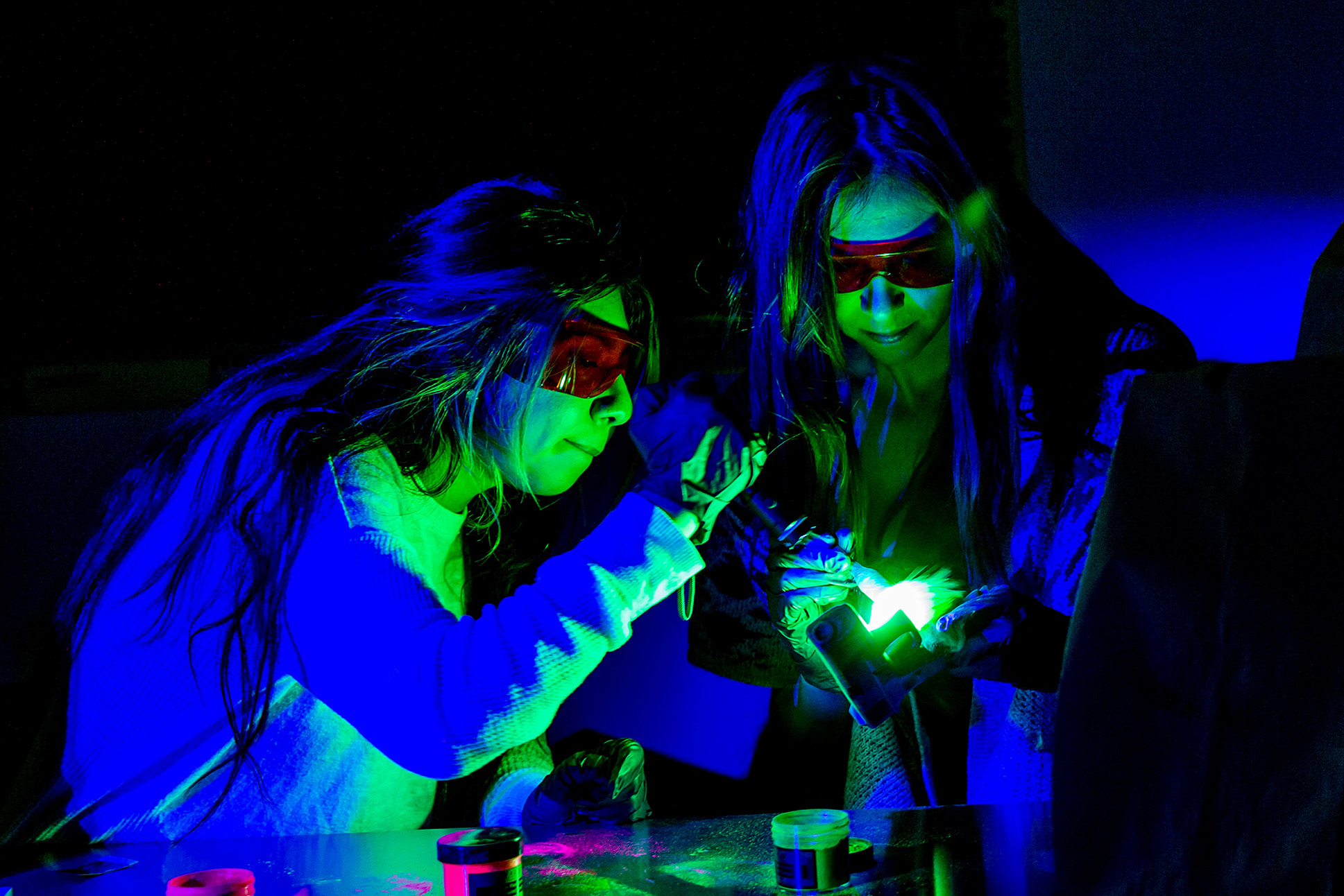
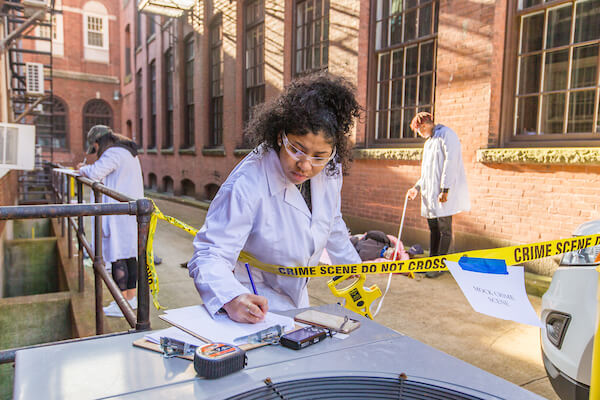
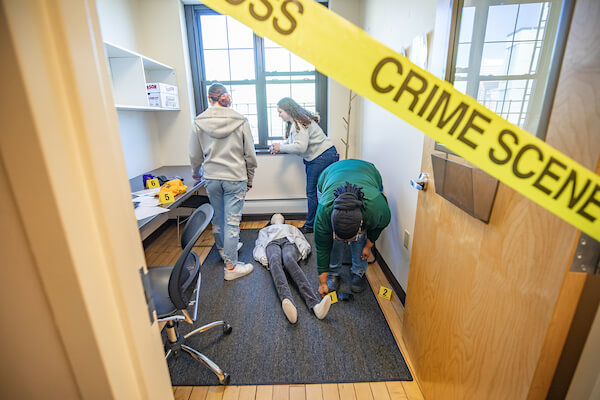
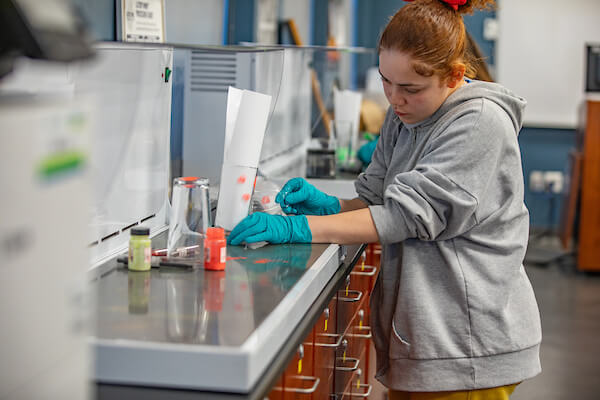
Practice applying investigative theories and evaluating evidence in JWU’s Crime Lab and Crime Scene Room, pursue approved internships or research, and choose electives or a Community Justice specialization aligned with your interests. The program develops communication, critical-thinking and ethical-reasoning skills for criminal justice careers or further education.
Students in the Criminal Justice program can choose to add a minor in Community Justice or Forensic Science to dive deeper into specific areas of the criminal justice field.
Criminal Justice at a Glance
- Specialization: Community Justice
- Sample subjects: Criminology, law enforcement, corrections, criminal investigation, homeland security, criminalistics and criminal law
- Applied learning: Internship, undergraduate research, honors experience or eligible study abroad
Curriculum & Degree Requirements
Also available as a three-year program in Providence and Online, and as an Accelerated Master’s program
Credits Major Courses | ||
| CJS1002 | Introduction to Criminal Justice | 3 |
| CJS1090 | Law Enforcement | 3 |
| CJS2040 | Corrections | 3 |
| CJS2050 | Criminology | 3 |
| CJS3075 | Criminal Investigation | 3 |
| CJS3850 | Homeland Security | 3 |
| CJS4045 | Criminalistics with Lab | 3 |
| CJS4080 | Criminal Justice Senior Seminar | 3 |
| LAW3015 | Criminal Procedure | 3 |
| LAW3025 | Criminal Law | 3 |
| Major Electives or Specialization in Community Justice | ||
| Choose five of the following: | 15 | |
| Criminal Courts | ||
| Juvenile Justice | ||
| Criminal Justice Ethics | ||
| Community Policing | ||
| Victimology | ||
| Comparative Criminal Justice | ||
| Cyber Crimes | ||
| Offender Assessment and Case Management | ||
| Advanced Topics in Criminal Justice | ||
| Advanced Topics in Criminalistics with Lab | ||
| Serial Killers | ||
| Community Justice | ||
| Restorative Justice | ||
| Race, Crime and Justice | ||
| Cultural Awareness and Diversity in Criminal Justice | ||
| Change and Innovation in Law Enforcement | ||
| International Relations and World Politics | ||
| Comparative Study of World Religions | ||
| Or | ||
| Specialization in Community Justice | ||
| Community Justice | ||
| Race, Crime and Justice | ||
| Change and Innovation in Law Enforcement | ||
| Choose two of the following: | ||
| Victimology | ||
| Offender Assessment and Case Management | ||
| Restorative Justice | ||
| Cultural Awareness and Diversity in Criminal Justice | ||
| Race, Politics and Power in America | ||
| Community Psychology | ||
| Psychology of Conflict Resolution | ||
| Applied/Experiential Learning | ||
| Choose 6 credits from the following: | 6 | |
| College of Arts & Sciences Internship | ||
| Undergraduate Research Experience | ||
| Honors Directed Academic Experience | ||
Study Abroad | ||
| Related Professional Studies | ||
| PSYC1001 | Introductory Psychology | 3 |
| PSYC2002 | Abnormal Psychology | 3 |
| RSCH2050 | Workshop in Acquiring Social Research Skills | 3 |
| SOC3060 | Deviant Behavior | 3 |
| University Core Curriculum | ||
| Communicating | 9 | |
| Rhetoric & Composition I | ||
| Rhetoric & Composition II | ||
| Communication Skills | ||
| Connecting | 6 | |
Two courses with the Connecting attribute (ECNG), one at the 2000 level, one at the 4000 level | ||
| Experiencing | 6 | |
| American Government | ||
Additional course with the Experiencing attribute (EEXP) in a different discipline | ||
| Measuring | 6 | |
| A Survey of College Mathematics (or higher, based on student’s placement) | ||
| Statistics I | ||
| Exploring | 3 | |
| Choose one of the following: | ||
| Introduction to Life Science | ||
| Introduction to Exercise Physiology | ||
| Anatomy and Physiology | ||
| Interacting | 6 | |
| Sociology I | ||
or SOC2005 | Honors Seminar: Social Inequalities | |
Additional course with the Interacting attribute (EINT) in a different discipline | ||
| A&S Electives | 6 | |
Two courses with the Arts & Sciences elective attribute (EASC) | ||
| Free Electives | ||
| 15 credits selected from 1000-4999 numbered offerings within the university | 15 | |
| Total Credits | 120.0 | |
|
Credits
Major Courses |
||
| CJS1002 | Introduction to Criminal Justice | 3 |
| CJS1090 | Law Enforcement | 3 |
| CJS2040 | Corrections | 3 |
| CJS2050 | Criminology | 3 |
| CJS3075 | Criminal Investigation | 3 |
| CJS3850 | Homeland Security | 3 |
| CJS4045 | Criminalistics with Lab | 3 |
| CJS4080 | Criminal Justice Senior Seminar | 3 |
| LAW3015 | Criminal Procedure | 3 |
| LAW3025 | Criminal Law | 3 |
| Major Electives | ||
| Choose two from the following: | 6 | |
| Criminal Courts | ||
| Juvenile Justice | ||
| Criminal Justice Ethics | ||
| Community Policing | ||
| Victimology | ||
| Comparative Criminal Justice | ||
| Cyber Crimes | ||
| Offender Assessment and Case Management | ||
| Advanced Topics in Criminal Justice | ||
| Advanced Topics in Criminalistics with Lab | ||
| Serial Killers | ||
| Community Justice | ||
| Restorative Justice | ||
| Race, Crime and Justice | ||
| Cultural Awareness and Diversity in Criminal Justice | ||
| Change and Innovation in Law Enforcement | ||
| International Relations and World Politics | ||
| Race, Politics and Power in America | ||
| Applied/Experiential Learning | ||
| Students in this program are required to complete 600 hours of Work Integrated Learning. | ||
| Related Professional Studies | ||
| PSYC1001 | Introductory Psychology | 3 |
| PSYC2002 | Abnormal Psychology | 3 |
| RSCH2050 | Workshop in Acquiring Social Research Skills | 3 |
| SOC3060 | Deviant Behavior | 3 |
| University Core Experience | ||
| Communicating | 9 | |
| Rhetoric & Composition I | ||
| Rhetoric & Composition II | ||
| Communication Skills | ||
| Connecting | 6 | |
|
Two courses with the Connecting attribute (ECNG), one at the 2000 level, one at the 4000 level
|
||
| Experiencing | 6 | |
| American Government | ||
|
Additional course with the Experiencing attribute (EEXP) in a different discipline
|
||
| Measuring | 6 | |
| A Survey of College Mathematics (or higher, based on student’s placement) | ||
| Statistics I | ||
| Exploring | 3 | |
|
Choose one from the following:
|
||
| Introduction to Life Science | ||
| Introduction to Exercise Physiology | ||
| Anatomy and Physiology | ||
| Interacting | 6 | |
| Sociology I | ||
|
or SOC2005
|
Honors Seminar: Social Inequalities | |
|
Additional course with the Interacting attribute (EINT) in a different discipline
|
||
| A&S Electives | 6 | |
|
Two courses with the Arts & Sciences elective attribute (EASC)
|
||
| Total Credits | 90.0 | |
Choose a Three-Year or Four-Year Bachelor’s Degree
You have the option to earn your Criminal Justice bachelor’s degree in either three or four years. Our Career-Focused Degree Program lets you complete your degree in just three years with a streamlined, 90-credit curriculum. This option allows you to enter the workforce sooner and save on tuition while still receiving the same quality education and hands-on experiences JWU is known for. If you prefer a more traditional pace, the four-year degree path is also available, offering the same rigorous preparation for your future career.
Criminal Justice Careers & Further Study
Graduates may pursue entry-level opportunities across public agencies, courts, corrections, security, investigations, social services and community organizations, or continue to graduate or law school.
- Court administration or legal-services support
- Corrections, probation or community-program support
- Loss prevention, security or private-investigation roles
- Local, state or federal law-enforcement pathways
- Victim services, social services or community justice roles
- Graduate study in criminal justice or related fields
Some professions may require additional study, background checks, certifications, licenses, exams and/or experience as required qualifications for employment. Students are responsible for verifying that they can meet the employment requirements of potential employers.
A Catalyst for Change
“My motivation for studying criminal justice stems from wanting to help people that the justice system ultimately fails,” shares Cordelia Dechellis ’24, who is pursuing her juris doctorate to become a criminal attorney through JWU’s 3+3 Law Program.
Compare JWU Criminal Justice Degree Options
- Four-year B.S. in Providence: A 120-credit campus program with electives or a Community Justice specialization and six credits of approved applied learning.
- Three-year Career-Focused B.S.: A separate 90-credit campus pathway with work-integrated learning and fewer electives.
- Online Criminal Justice: A separate online format for students seeking remote study. Curriculum and availability should be reviewed on the online program page.
Considering an advanced degree?
While completing your bachelor’s degree, you can also begin work on an online Master’s in Criminal Justice degree through JWU Online. Or, take advantage of our 3+3 Law Program to earn a bachelor’s degree from JWU and a juris doctor (JD) degree from either Roger Williams University School of Law or University of Massachusetts School of Law in just six years.
Study Criminal Justice in Providence, Rhode Island
Students study the American criminal justice system, criminology, law enforcement, corrections, criminal investigation, homeland security, criminalistics, criminal procedure and criminal law while developing research, communication and ethical-reasoning skills.
The Providence Criminal Justice B.S. is designed as a four-year, 120-credit program. JWU also offers a separate three-year Career-Focused degree. Completion time may vary based on transfer credit and academic planning.
The Community Justice specialization examines prevention, restorative justice, community building, cultural awareness and change within justice systems through an interdisciplinary group of courses.
Yes. Students may learn in the Crime Lab and Crime Scene Room and complete an approved internship, undergraduate research experience, honors project or eligible study abroad. Activities and availability vary by course and opportunity.
A Criminal Justice B.S. can develop research, writing and analytical skills relevant to law school, but it is not a law degree. Law-school admission and attorney licensure require separate education, testing and other requirements.
Graduates may pursue opportunities in courts, corrections, investigations, security, loss prevention, social services, community organizations and government. Many law-enforcement and federal roles have separate academy, examination, background, citizenship, physical or experience requirements.
JWU also offers separate online Criminal Justice options. Students should compare curriculum, format and availability on the applicable program pages.
Faculty Contact
Paul Sylvestre, Ph.D.
Professor and Department Chair
401-598-2214
paul.sylvestre@jwu.edu