A few years ago, Kristina Johnson ’24 was working as a secretary at Newport Hospital in Rhode Island. Interacting with nurses in her administrative role, she became increasingly interested in their work.
“I was able to see what they do day-to-day,” she says. “They wear so many hats — they’re able to do the job of several people at once, and I was just in awe of that.”
Johnson already had a bachelor’s degree in biology and had toyed with the idea of a medical career but doubted she had the time to go back to school. Luckily, her manager knew about the new Accelerated Bachelor of Science in Nursing program at Johnson & Wales. “It was exactly what I needed,” says Johnson. “It was a second bachelor’s degree. I didn’t have to waste my first degree, and I was able to get an accelerated program that took the prerequisites I already had.”
Johnson became part of the first cohort to graduate from the four-semester program, which welcomed students in August of 2023. The Charlotte campus welcomed its initial cohort the following spring, and the program, in both locations, earned national accreditation from the Commission on Collegiate Nursing Education in 2025.
Graduating in December of 2024, the inaugural cohort at JWU’s Providence campus achieved a 100% first-time pass rate on the National Council Licensure Examination for Registered Nurses (NCLEX-RN).
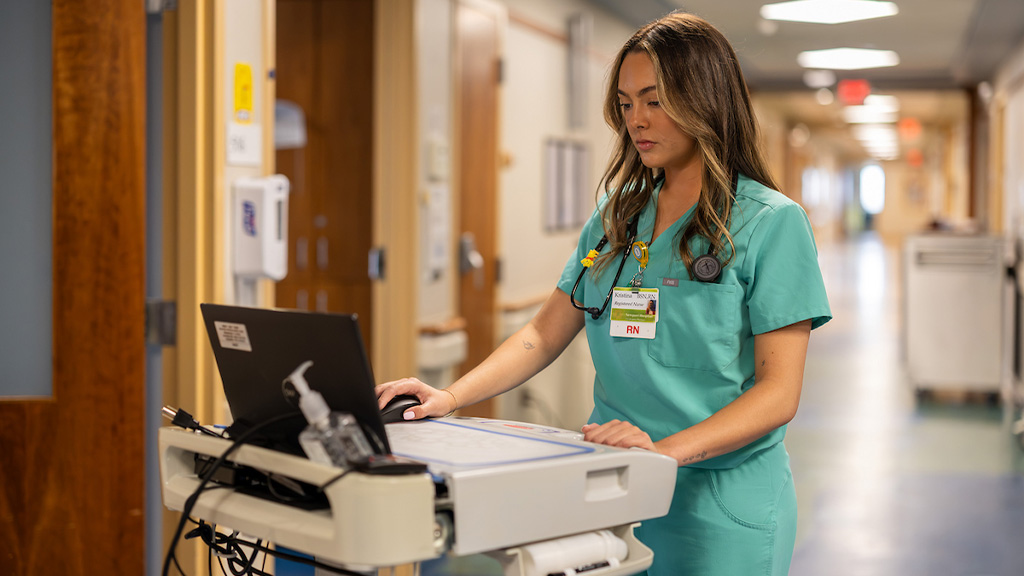
Johnson now works as a medical-surgical nurse on the night shift at Newport Hospital, taking care of patients on the adult cardiac and stroke floor. She has been there for a year now and after just a few months was promoted to the position of charge nurse, responsible for overseeing the other nurses in her unit.
Second-degree accelerated programs are offered in many places, says Kiley Medeiros, Ph.D., RN, nursing program director on the Providence campus. “What I think Johnson & Wales does differently is the face-to-face opportunity. The majority of accelerated programs are fully online with just in-person clinicals. We are brick and mortar. You come to class, ask questions, meet and collaborate with your peers and get to ask your faculty members questions directly.”
The small cohort sizes also set the program apart. “The program’s largest cohort came in at 35 last fall,” says David Hudson, DNP, MSN, RN, the Charlotte campus’s nursing program director, “and that’s about the largest that we want to see. It makes us big enough to have a footprint in the area, but small enough for the faculty to still be able to interact with all of the students.”
Think Like a Nurse
Within the first two to three weeks of starting the program, students are introduced to clinical rotations, where they spend time at area hospitals, as well as class sessions in the on-campus simulation lab.
“I joke and tell people that it’s bed, bath and vital signs,” says Hudson of the first semester Foundations in Nursing Practice course, “but it’s also about communication and teaching the student how to deliver safe nursing care. We’re teaching them how to start thinking like a nurse from a clinical judgment perspective.”
For first-semester student Max Glaser ’27, even simple techniques like using a stethoscope have proved fascinating. “When my classmates and I listen to each other, we hear the normal laminal flow. But when I’m in the hospital and I put my stethoscopes up to a patient, hearing the different lung and heart sounds is very interesting, especially with people presenting with different conditions. I’ve never really spent time with a stethoscope around my neck before.”
Pathophysiology, or, as Hudson puts it, “the body gone bad,” also begins in that first semester. “So, as well as learning about how the heart functions, we’re talking about the disease processes that are happening when the heart doesn’t function.”
The Bigger Picture
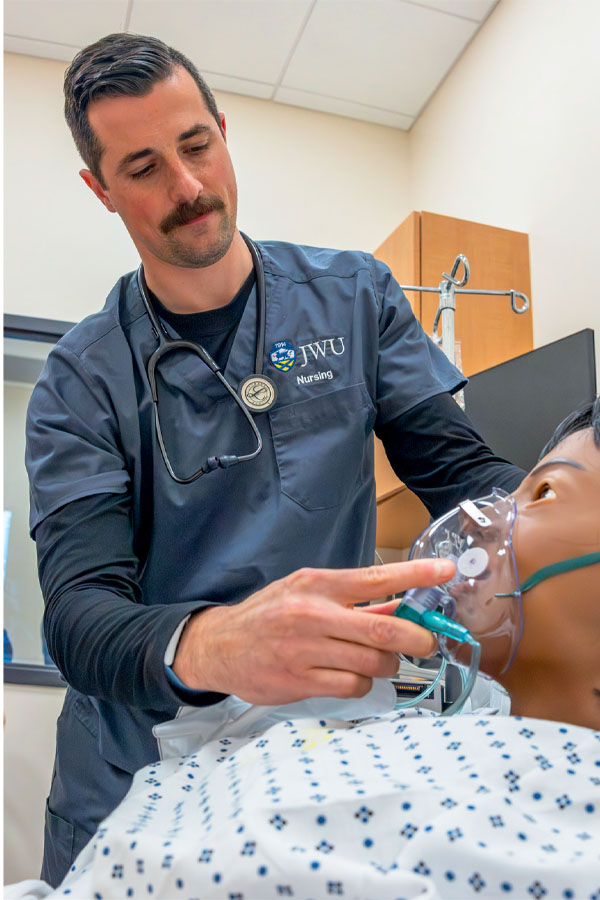 In the sim lab, students start learning how to give medications and take health assessments, where they learn to look at the patient as a whole, says Hudson. “Not just their body, but their psyche, their bigger picture, their family life, their personal things, the things that make them click, and how they all impact their health.”
So yes, says Hudson “they’re learning how to listen to your heart and your lungs and take your blood pressure and shine lights in your eyes and do all those things that you see your doctor doing and on TV, but also a lot more. And there’s sim lab right out of the gate.”
On both campuses the sim labs are a blend of high and low tech. “We have simulators that are very realistic, that talk, that breathe, that have heart sounds, lung sounds, bowel sounds and body fluids,” explains Meredith Joyner, DNP, RN, an assistant professor and simulation lab manager on the Charlotte campus. When she is running a lab, she can change the mannequin’s vital signs directly from her laptop and even talk through the mannequin.
“When they first start the program, the students, tend to be kind of standoffish with the mannequins — they have a hard time suspending reality,” says Joyner. “By the end of the program, they’re having conversations with it just like they would with a patient.”
Depending on the simulation, students sometimes interact with a faculty member or fellow student acting as a patient rather than a mannequin. “There are some things that I can mimic with our mannequins better than I can with a person, and vice versa,” says Jonathan Carpenter, MSN, assistant professor and simulation lab manager on the Providence campus. “We actually have a lot of people volunteering to be a medical actor. It’s just fun.”
“What’s going on with this patient?”
Early in the program, students in the sim lab practice simple techniques such as inserting a Foley catheter and learning how to safely turn a patient in bed or assist someone from the bed to a standing position into a wheelchair.
“We’re also trying to build up their confidence in communicating with a patient,” says Carpenter. “They’re learning how to walk into a room and talk to someone and establish that nurse-patient relationship, and that can be really hard when you’re first starting out.”
Even at this early stage, the simulations are also building up critical thinking skills. As Joyner explains, the students might have orders to administer medication, but there may be something wrong with the dosage or the patient has a reaction to the medication. “They have to recognize that there’s an allergy or that the patient’s getting sicker. The skill may be putting in a urinary catheter, but they’ve got critical thinking points of medication administration that they have to think about. What’s going on with this patient? How do I deal with that?”
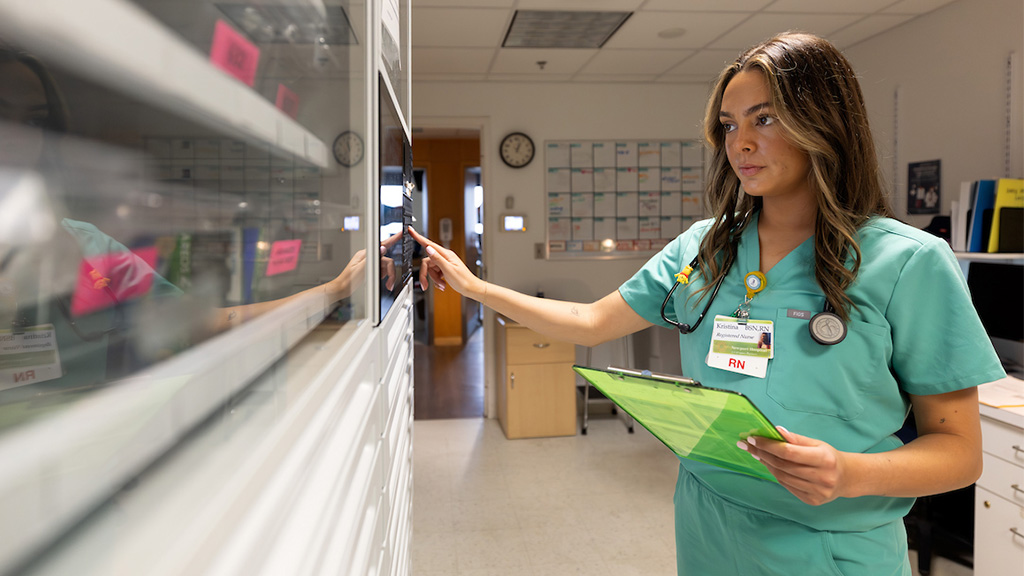
Nerves among new students are common. Johnson remembers how even doing simple actions early on, such as introducing herself to patients, handing out medication or giving injections caused her anxiety.
“I will never forget one of my professors telling me that the day you are no longer nervous, you should be worried,” she says, “because being an overconfident nurse can be dangerous. Being exposed to things over and over again made me less anxious. I was able to practice injections in the sim lab and then discuss with my professors that it was something I wanted more practice with in clinicals, which ultimately allowed me to gain more trust in myself. After a year of being a nurse I still get nervous, but I like to call it cautious.”
Carpenter starts his sim classes by assuring his students that they are in a safe learning environment and that he wants them to make mistakes because then they can come back together and reflect and talk about them. “What happens in sim, stays in sim,” he says.
“Coming out of it,” he adds, “they always say that it's one of the best experiences that they have because it’s where you get the most condensed skill training in nursing school. When we're on an eight-hour shift on an orthopedic floor or a cardiac telemetry floor, you may only get to do a skill if that patient happens to have something that requires you to do it.”
Johnson also found her first clinical rotation, in a nursing home, stressful at first. “We were nervous to put a patient to bed or to help somebody walk because we were still new to the basic maneuvers of getting somebody somewhere safely. Are they going to choke when you feed them something?”
They’re learning how to walk into a room and talk to someone and establish that nurse-patient relationship, and that can be really hard when you’re first starting out.Jonathan Carpenter Assistant Professor and Simulation Lab Manager
Building the Complexity
In the second semester, students move on to understanding chronic disease processes. “They’re not looking at someone who’s had a heart attack today,” explains Hudson. “Instead, they’re assessing someone who had a heart attack a week ago and figuring out what happens now.” A mental health course, with its own freestanding mental health clinical experience, also happens during this semester, as well as a unit on pharmacology.
As a component of the mental health class, Carpenter runs a psychiatric simulation with a patient acutely detoxing from alcohol, so students can experience what it’s like when a patient becomes aggressive and starts becoming psychotic. While these are common situations that nurses will likely see in practice, in clinical settings, for student safety, if anyone becomes aggressive the first thing an instructor will do is pull them out of danger. “This is a great opportunity,” he says, “for them to be involved in a situation they’re not going to be able to experience in a clinical practice setting.”
For Johnson, pharmacology was one of the most challenging classes. “I think it’s difficult for a lot of people just because it’s less to do with hands-on learning. You see a slide, you memorize it. Now I’m in the field, I realize how helpful it was because I’m still thinking of the rhymes I made up to jog my memory, and I always think ‘Wow, that's crazy that I still remember that.’ So, it did end up being really useful.”
The third semester introduces students to pediatric nursing and maternal newborn nursing, each of which has an associated clinical component. Since students may not always see a delivery when they’re on a clinical rotation, Joyner simulates a delivery for them in the lab with a mannequin that can birth a baby. She also stages a postpartum hemorrhage, a common obstetrical emergency. “We try to really put them in those critical situations that they will probably encounter as a nurse.”
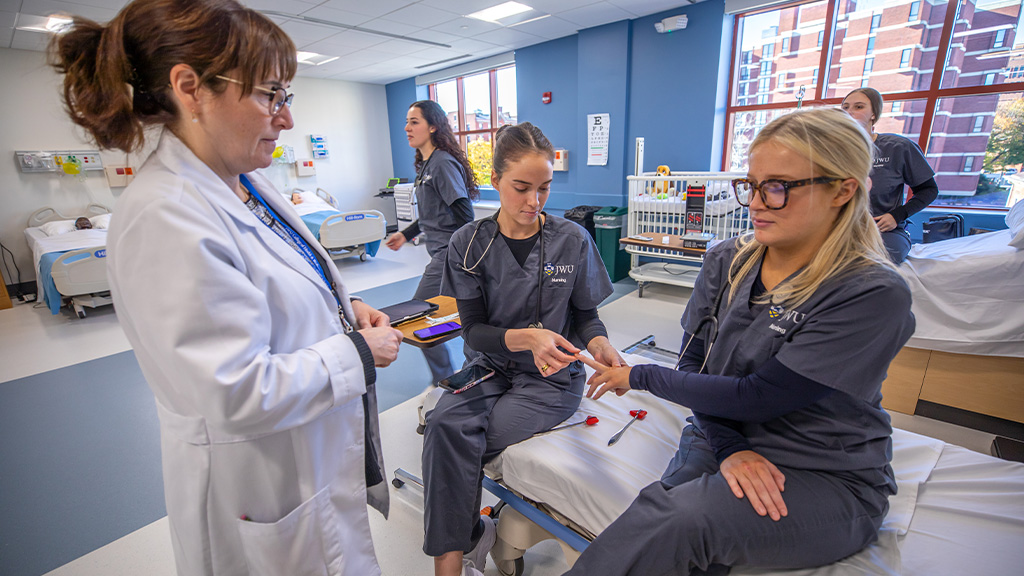
The final semester is the most exciting for students, says Medeiros, with a Care of the Adult course focused on acute illness and simulated medical emergencies with many moving parts. A patient may come in with chest pain, and the students have to determine if it’s a heart attack or not. Another might present with a stroke. Somebody else has diabetes and experiences an acute diabetic issue.
The last simulation Joyner runs with her students addresses prioritization, with three people with evolving disease processes that are getting sicker. The students have to prioritize care around who they will attend to first. “The patients have call bells, so the nurses get interrupted,” says Joyner. “They get phone calls from the doctors and the lab. This is what it’s really going to look like when you have three patients to care for and all three need things, and you’re getting constant interruptions.” After the simulation, the students will debrief and talk about their thought process and why they chose to prioritize a particular patient.
A Glimpse of the Future
In their final semester, students also learn about community and population health nursing. The aim is to give them an understanding of the resources available to clients in their area. Do they have 24/7 transportation? Do they have a stable home to go to? Do they have food and electricity? Even if students are not planning on going into this area of nursing, Medeiros says, the training is valuable because “patients are leaving the hospital, and as a nurse you have to understand what is available to them once they’re discharged.”
Students at this stage of the program are also trying to figure out their professional identity within nursing, and that’s where the one-on-one practicum plays a vital role. Each student is paired up to work with a nurse in a hospital setting caring for adult clients. “It’s a really strong professional building semester for the students, going from being one of eight in a clinical group following their clinical instructor to being a standalone,” says Medeiros.
Johnson was fortunate, she says, to have been placed in a medical surgical unit at Westerly Hospital in Westerly, RI. “It’s similar to the one I work in now,” she says. “I worked with a registered nurse, and it was valuable because it gave me a different perspective. I created a different rapport and relationship with the nurse as well as with the patients, one that I wasn’t able to fully obtain in a group setting. I got to apply the skills I learned in class, clinical and simulation as a ‘real’ nurse. It gave me a glimpse of what my future held.”