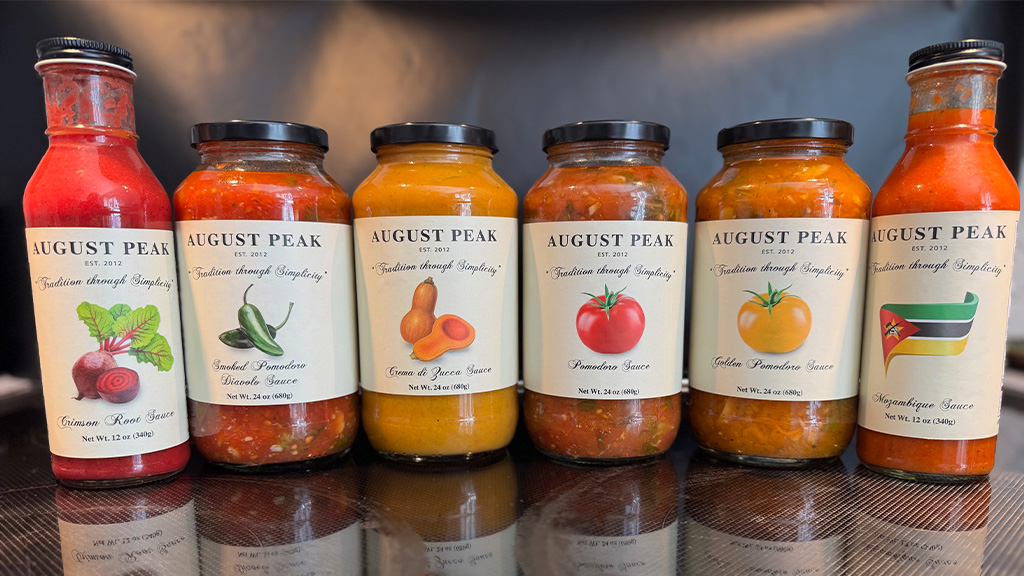
When William Ferlauto ’91 came up with the idea of jarring and selling a line of tomato sauces, he knew he’d have to jump through a few hoops.
The easy part was coming up with the recipe. He’s been making the sauce — with fresh, ripe tomatoes, toasted garlic, basil and high-grade extra virgin olive oil — since he was a teenager growing up in New Jersey.The regulatory hurdles seemed more daunting. To sell his August Peak line of sauces he would need to file an application with the Department of Health and have his product analyzed to ensure its safety. To his relief, Ferlauto, who lives in Warren, Rhode Island, discovered he could take care of every step of the testing process at the Ecolab Center for Culinary Science on the Johnson & Wales Harborside Campus.
“It worked like a charm,” says Ferlauto. “The lab helped me legitimize everything and gave me the pH and the breakdown of sodium and everything I needed to create an actual nutritional label to go on the jars.”
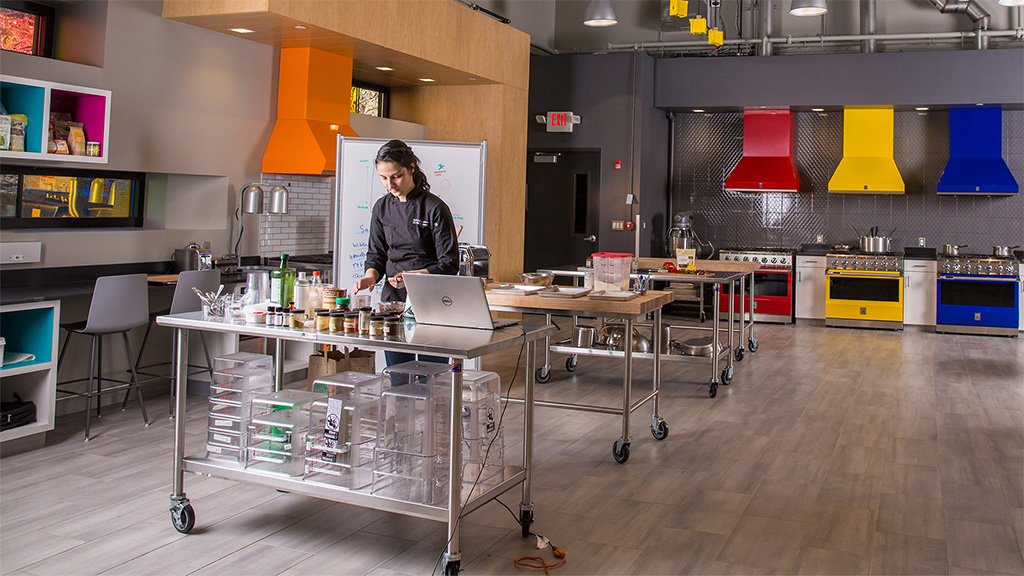
Johnson & Wales has been in partnership with Ecolab, a global safety and sustainability leader, since 2017, when a gift agreement funded the creation of the Ecolab Center and its anchor space, the Food Innovation Design Lab, along with an endowment to fund operations and support student scholarships.
For the first few years, the Ecolab Center focused largely on programmatic and curriculum support, helping to get JWU’s Sustainable Food Systems bachelor's degree and the master's in Food Innovation and Technology off the ground and running.
When Jason Evans, Ph.D., arrived as dean in 2018, he pushed for the center to play a broader role. “I was brand new to Rhode Island and to its food and beverage landscape,” says Evans. “It was pretty clear to me that the center could and should play a role in the food and beverage entrepreneurship ecosystem here in the Northeast, so we set about finding a director with the food science chops to orchestrate everything we wanted to do.”
Enter Ruben Morawicki, Ph.D., formerly an associate professor in bioprocessing at the University of Arkansas and a senior research scientist at Tyson Foods, who became director of the Ecolab in 2022 and also serves as a professor in JWU’s Culinary Science program. “Through testing, we determine if the product is safe or not,” says Morawicki. “And if it’s not, we tell them what they can do. And if eventually the product is not feasible, we tell them so.”
Specifically, what the Ecolab Center offers is product evaluation for acidified foods. FDA regulations require that all shelf-stable acidified products — such as pickles, salsa and BBQ sauce — be evaluated for safety by a facility known as a process authority, which analyzes the product, reviews the manufacturing process and list of ingredients, and provides paperwork confirming its safety. The Ecolab Center is Rhode Island’s only process authority.
Several well-established food companies take advantage of the Ecolab Center’s services, though the majority of its clients are small entrepreneurs or people just starting a business. “They need a lot of hand holding,” says Morawicki, “and that’s what we do.”
Since Morawicki’s arrival, the lab has undertaken lab analyses for hundreds of individual clients and products. “At the end of the day,” says Evans, “it’s a great source of non-tuition revenue to support the extension arm of the College of Food Innovation and Technology.”
Beyond food safety and testing expertise the Ecolab also provides in-depth consulting to food and beverage entrepreneurs around product research and development.
For example, says Evans, “a Canadian seafood company approached us because it was getting a lot of bycatch — species that show up in the nets when they’re harvesting their primary catch — and they didn’t have a market for those bycatch species, like razor clams. They wanted us to help develop product platforms that they could then take to their clients in fast casual or fast food.” That project spanned a year and a half and tapped the knowledge and experience of several JWU faculty.
JWU students intersect with the Ecolab, too. In junior and senior level labs, students get to design their own restaurant menus, which often involve processes — such as fermentations or sous vide applications — that technically would require a variance from the Department of Health. Morawicki works with the faculty and students in those classes to understand the processes and write safety plans that are then posted in the labs, helping to educate the young chefs on what a food entrepreneur would see from a regulatory standpoint.
This spring, the center welcomed its first intern, Terrene Huang ’26, a Culinary Science and Product Development major who became interested in food safety when she took a food processing class with Morawicki in her first semester.
Huang’s internship duties include helping Morawicki with lab analyses of food products: measuring pH levels, assessing water content and determining shelf life. She also is heading up a pilot program to produce a line of JWU branded packaged foods based on recipes developed by students on the Providence and Charlotte campuses last year (with USDA grant funding) that use maple syrup as a hero flavor.
From a wide array of recipes — maple banana bars, maple ice cream, maple vinaigrette and a maple chili crisp — Huang will pick one or two to test, assessing market potential and manufacturing feasibility. Students will take full ownership of the production schedule and manufacture the branded products, which will be sold at campus venues.
“What I want to be able to continue to learn is how to bring good food practices to places that I work in and to communities around me,” says Huang, who also has a degree in industrial design. “I hope to combine my background in product development and design with my culinary passion and love for food.”
Beyond any singular project, Dean Evans sees an overall benefit for students from having so many local and regional food entrepreneurs actively engaged with the Ecolab Center. “We now have this treasure trove of fledgling entrepreneurs that we can access and get in front of our students — whether that’s an event, classroom presentations, speaker series — all working in a business that many of our students want to break into.”
Moving forward, Evans sees Johnson and Wales, with the help of the Ecolab Center, positioning itself as a thought leader in food safety, especially as it relates to novel kitchen techniques that don’t yet have long-standing food safety parameters around them.
“Johnson and Wales and the Ecolab Center will be a hub for understanding the food safety implications of those new techniques and technologies,” he says, “so that departments of health all over the country will have a much better understanding of what they see when they walk into these really progressive kitchen environments.”