Culinary
Alumni
Hospitality & Business
Experiential Education
Culinary
Hospitality & Business
3 Ways JWU Creates Culinary and Hospitality Leaders
Author Mason Hemsley '26 is a Fashion Merchandising & Retailing major and works as a student assistant at JWU, contributing to JWU News.
JWU is known for world-renowned culinary and hospitality programs. These programs take students beyond working in kitchens or hotels — we teach them how to be leaders in their industries and manage different scenarios through hands-on courses and projects. Through our Reimagining Experiential & Active Learning (REAL) approach, every course offers students the chance to drive their own learning and apply what they’ve learned to future experiences.
Here are three unique ways our culinary and hospitality students step into leadership roles in the classroom.
Bistro 61: Learning to Manage a Restaurant
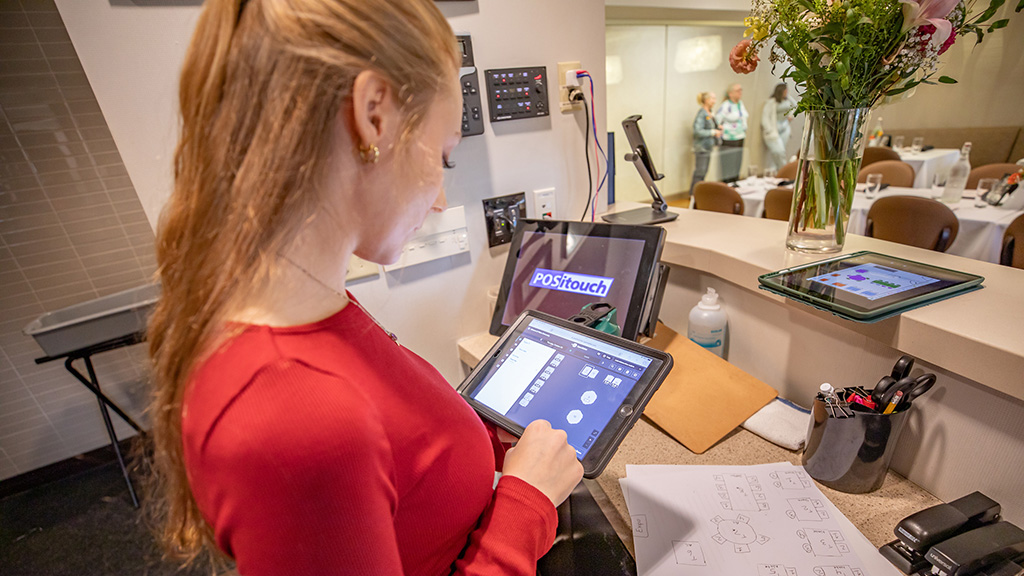
Bistro 61 is a fully functional restaurant at the Providence Campus and is managed by students as part of a capstone course in the Food & Beverage Industry Management program. Associate Professor Nicholas Makris oversees the experience for students. “Bistro 61 was specifically created as part of the program, and the responsibilities of the students are heavily on the management side,” says Makris.
Students take responsibility for every element and part of this operation. According to Makris, they handle financial planning and literacy, marketing and technology as well as menu costing, analysis and development. It all culminates in a full production service for campus guests. This experience mirrors a real-world restaurant environment and requires students to rotate through all roles, ranging from front-of-house to kitchen prep.
View this post on Instagram
“It gives students the opportunity to actually experience what it takes to run a restaurant,” Makris says. “For example, they will be servers, they will be cooking in the kitchen and they will be doing prep. Most importantly, they will be a manager at some point, and this provides hands-on experience needed to successfully run their own food service operation.”
Makris comes with plenty of industry experience — he has owned a restaurant for over 20 years. "There's a misconception that running a restaurant is strictly cooking — what we actually sell is a full experience,” he shares. “That experience does entail the food and the beverage, but it also consists of how we make our guests feel — like they’re still home but actually dining in a restaurant.”
Curating that kind of experience is no easy feat, but JWU students learn how to do it in Bistro 61. “We build a concept, create a menu and essentially build the overall environment of a restaurant,” says Kayla Hinton ’26. She and Erika Grover ’26 recently co-managed a service together. “This class shows us what our future could look like and how much goes into management,” says Grover. Both students credit the course with preparing them to lead, think quickly and prioritize the guest experience— skills they now hope to carry with them in future studies and careers.
Global à la Carte: A Culinary Journey Around the World
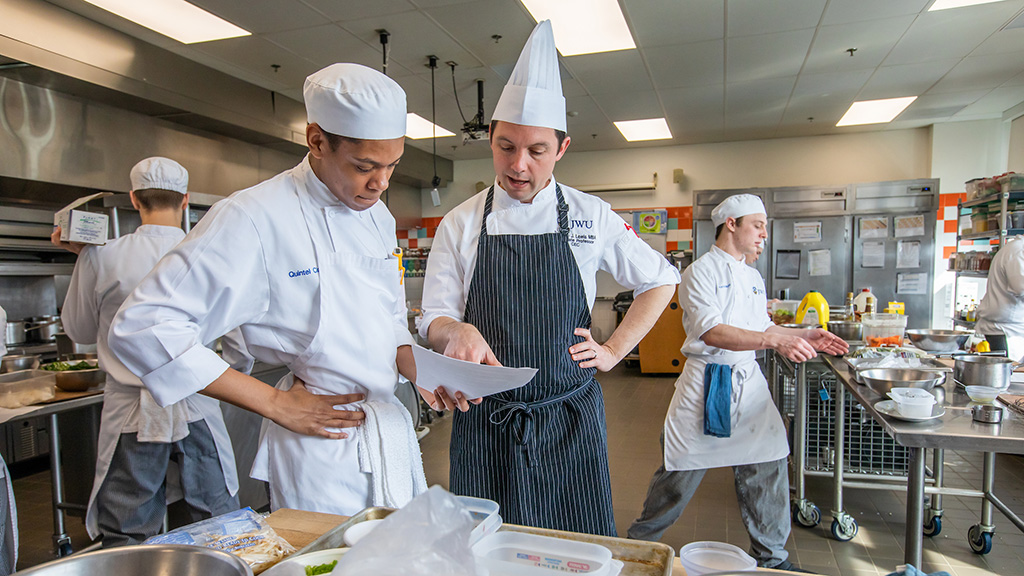
The CUL2810 Global à la Carte course, often taught by Professor Branden Lewis, takes students on an international culinary tour while teaching them to cook in a la minute (cooked to order) restaurant style environment. “Students learn cuisines, ingredients and cultural influences from around the world while actively firing tickets, which is a standard practice in restaurants everywhere,” Lewis says.
Across a 15-day rotation, students move through regional cuisines, starting in the Americas and progressing through Europe, the Middle East, North and East Asia, and finally Southeast Asia. Lewis notes that even as an expert, he continues to learn through this journey. “Students from different parts of the world bring their own traditions and cultures,” he says. “Sometimes a student will say ‘my mom makes it this way,’ and it ends up being the better method.”
View this post on Instagram
For culinary student Miriam Glenn ’28, the course expanded both her technical skill set and her overall global perspective. She explains that the immersive nature of this course pushed her beyond the foundations of French gastronomy, allowing her to apply international techniques and ingredients in a fast-paced kitchen setting.
“From learning how to use a wok to developing rich flavors with exotic spice blends, I gained a deeper understanding of the history and traditions behind cuisines from around the world,” Glenn says. She adds that working under a chef who had personally experienced these cultures through travel elevated the learning experience, noting that Lewis emphasized not only execution, but also an understanding of equipment, plating styles and flavor profiles unique to each region. “I even learned new information about my own heritage,” she says, calling Global à la Carte one of her favorite courses to date.
For students pursuing a career in the culinary field, Lewis believes this course is pivotal to their success. “It helps them become better cooks, better eaters and more cognizant of the communities around them,” Lewis says. “In a restaurant sense, learning how to cook and execute it well, tasting and building flavors, and understanding how those cultural ingredients are applied to the craft of cooking are all going to give you better results and a great experience that you can build off of in your career or in your life.”
Culinary Pop-ups: Creativity Through Concept and Execution
Culinary pop-ups are a temporary restaurant or one-time dining event that can appear in an untraditional location. While at JWU, culinary students are challenged to design and execute their own original pop-up concepts in rapid, real-time settings. These projects are overseen by Chef Matthew Britt, who serves as a mentor/guide to the students.
“I set the parameters and guardrails, and the students do the rest.” Britt explains. “They build the concept, identify the market and solve the problems that come with bringing their pop ups to life.”
View this post on Instagram
Culinary student Hannah Stewart ’28 shared that while each lab has its own structure, creativity remains a core element of each experience. "The lab that I'm currently taking requires us to have a certain number of dishes within a certain category — like soup, salad or sandwiches,” Stewart says. “But the lab I took with Chef Britt required us to have three courses with complementary drinks and bread, though the food we produced could be whatever we wanted.”
That balance of structure and creative freedom is what makes these pop-up experiences so impactful. According to Stewart, students are encouraged to explore a wide range of themes and concepts, often taking inspiration from regional or national cuisines such as Turkish or Creole, while others lean more into the imaginative side. “In the Corporate Dining Concepts Lab, the two groups this semester are doing Fairytale and Southern Brunch,” she says. “Past themes have included international holidays, ‘Around the World,’ and even ‘Super Bowl’ or stadium food.”
Once a theme is selected, students then use their class time to refine their chosen concepts and build menus that meet the requirements. This time is often used for research, collaboration and development, with the chefs available to answer questions and provide feedback. “We get a few days to recipe test everything,” Stewart explains. “That way we can fine-tune our dishes before pop-up day. The chefs give us feedback, we rewrite recipes, and the day before service we get a full prep day so we’re as ready as possible.”
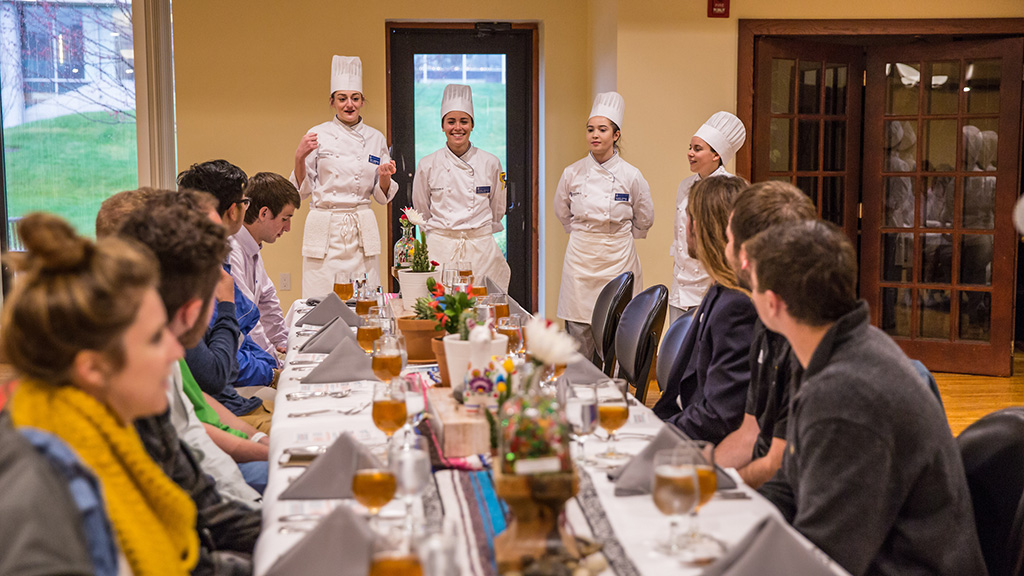
This hands-on approach gives students invaluable, real-world skills. “Students get to dive into a concept, which eventually leads to problems they must solve,” Britt says. “This is problem-based experiential learning at its finest.” Because pop-ups are required within the culinary arts bachelor’s degree program, every student gets a chance to participate.
“It gives us more perspective into the restaurateur process, as we have a lot more control and room for creativity than we do in other labs,” says Stewart. “It's also a great experience for leadership development and teamwork skills, as our teams were larger and were structured more similarly to that of a restaurant kitchen.”
Throughout each semester, new pop-ups appear across multiple culinary labs, offering free dining experiences to the public. Those interested can follow @popup_jwupvdculinary to learn more about upcoming concepts and services.
Related Posts
Experiential Education
Arts & Sciences
What Does a Cybersecurity Internship at JWU Look Like?
Alumni
Hospitality & Business
From JWU Student to Restaurant Owner: Andrea Cabrera
Culinary
Students