
How a Summer Stint at the Modern Supercharged a Young Pastry Chef’s Skill Set
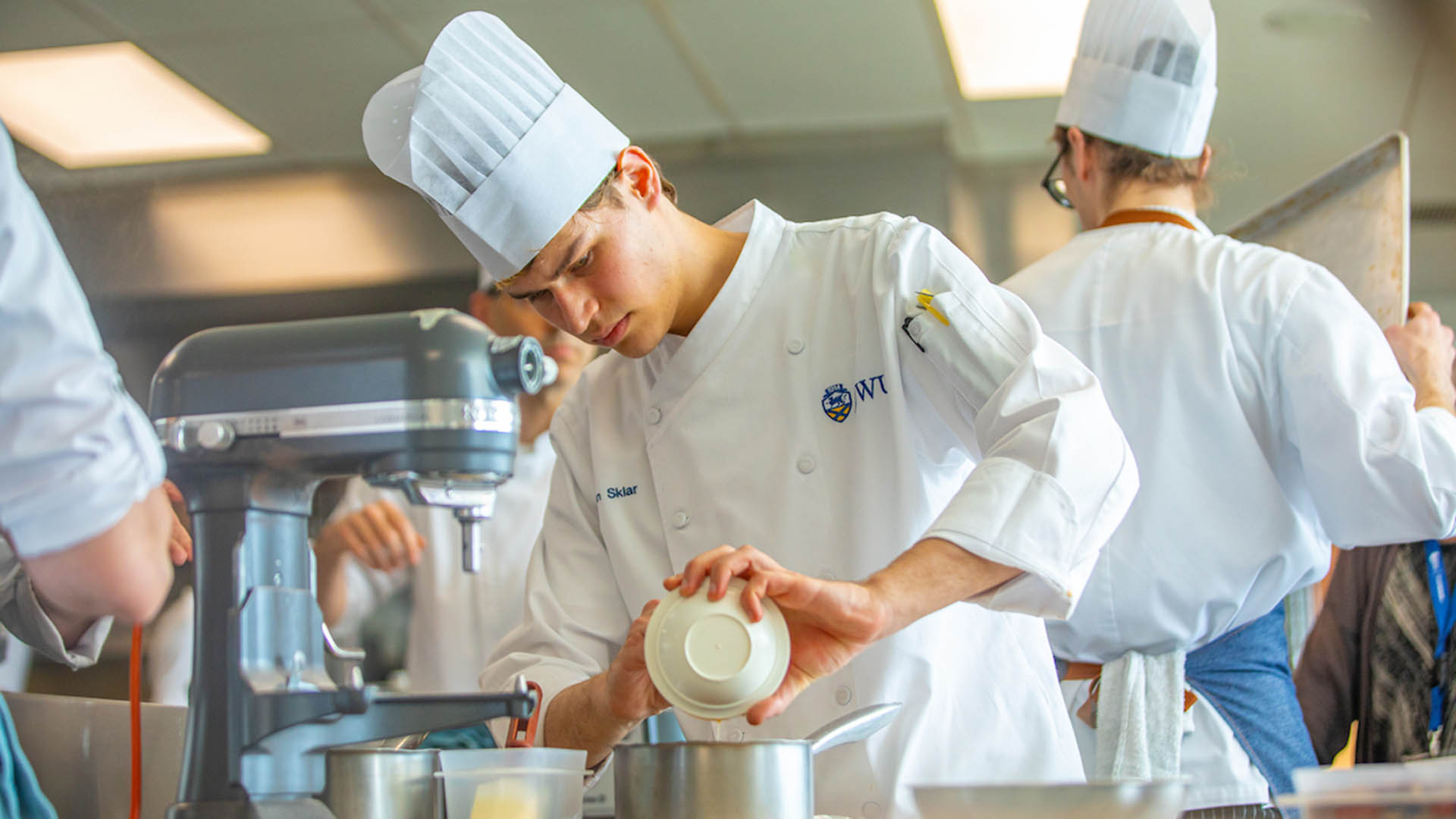
Growing up in New York City, Daron Sklar ’27 took advantage of every opportunity to learn from its renowned chefs. Since the age of 16, the Culinary Science & Product Development major had spent time working in some of the best kitchens in the city — including Eleven Madison Park and Kappo MASA — soaking up experience and expertise along the way.
Nothing could prepare him, though, for the steep learning curve he encountered when he worked this past summer as a pastry line cook at The Modern, the flagship restaurant of New York’s Museum of Modern Art. “I came into JWU with a little bit of industry experience,” says Sklar, “but nothing on the scale of this restaurant.”
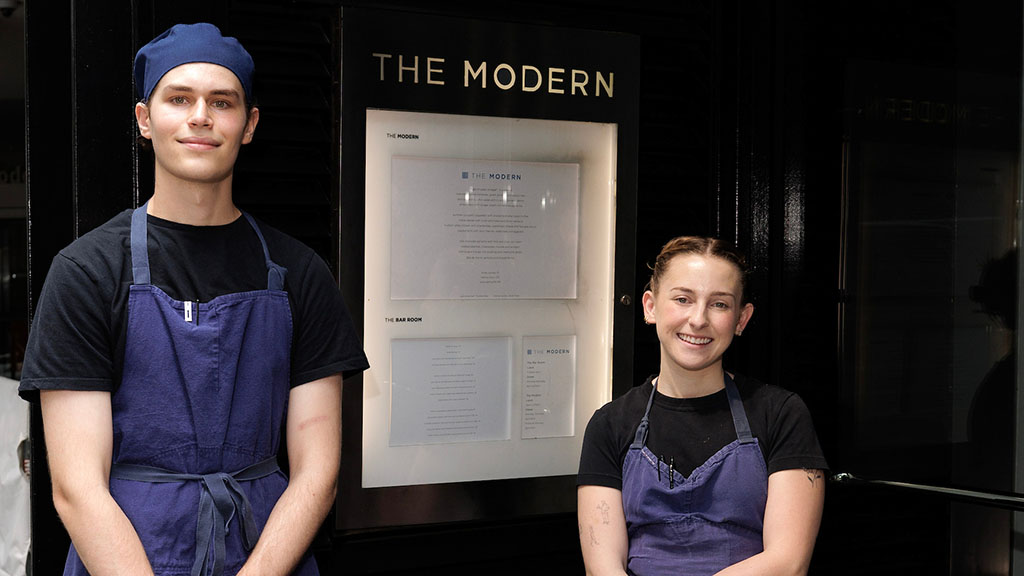
The opportunity to work at The Modern came about thanks to Charlotte Brecher ’18, the restaurant’s executive pastry chef, who was excited to hire a student from her alma mater, especially one who came highly recommended by Assistant Dean TJ Delle Donne. She fully anticipated that Sklar would feel overwhelmed.
“This is a huge, huge team,” explains Brecher, who began working as a sous chef at MOMA in 2021, after stints at Manhatta and Daily Provisions. “We have The Modern, which is the bar room and the main dining room, and then we also have our private dining room. On top of that we have the Garden Bar, which serves ice cream, the Espresso Bar, which serves pastries and coffee, and we also operate all the cafes at MOMA as well as the staff café, which feeds all the employees. Each of those restaurants will do 400 to 500 covers a day. We have seven binders of recipes, around 15 cooks, two sous chefs and me.”
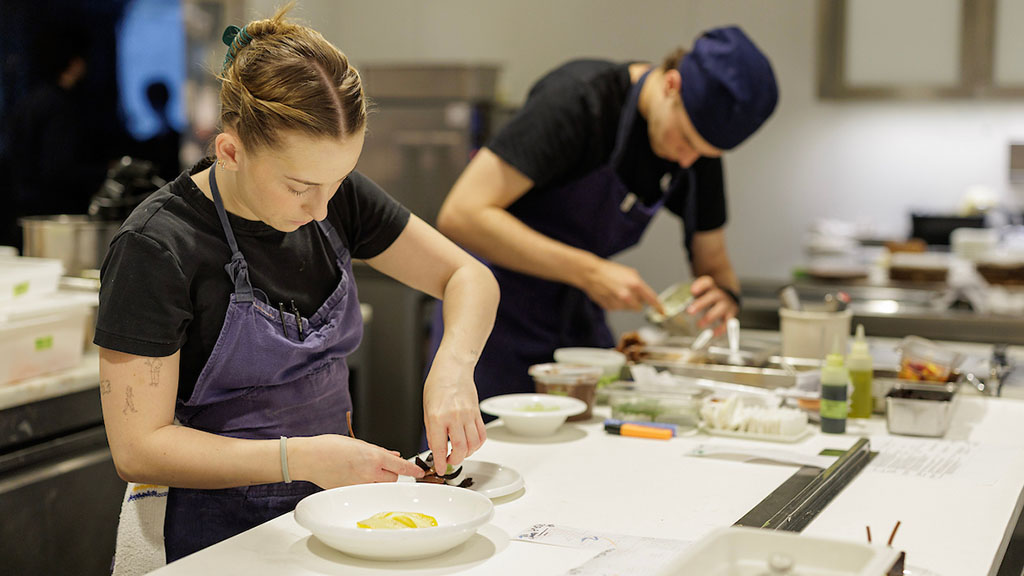
Working as a pastry line cook and production cook, Sklar gained valuable experience in both production and service. On a typical service day, he would spend the morning finalizing dessert components — whipping up ganaches, smoothing out a cheesecake, shaving melon, poaching rhubarb — before tasting all the dishes for consistency and launching into several hours of service.
“It’s definitely the most challenging place I’ve worked,” he says, “just because there’s so much happening and so much to do, and it’s all so detailed. I really had to develop my skills and efficiency, learning to think for myself a bit more in the kitchen and trying to anticipate problems before they came up.”
Sklar says his classes at Johnson & Wales prepared him well in terms of “having the knowledge and the background and knowing the science behind how everything works.” At The Modern, everything was just on a much larger scale.
For example, he says, “In my Advanced Pastry Applications Lab at JWU, we were making 300-gram batch sizes of crémeux. When I got here, the first thing I did was make 9,000 grams of crémeux. When it’s on such a large scale, things can change with the timing and temperatures.”
At first, Sklar says, he would go home after his shift, run through his day and realize all the things he had forgotten or put back in the wrong place. To help feel more organized, he created a checklist on his phone for service set up. “I don’t know how many bullets it had, but at least 35,” he says. With each day, it became a little less overwhelming.
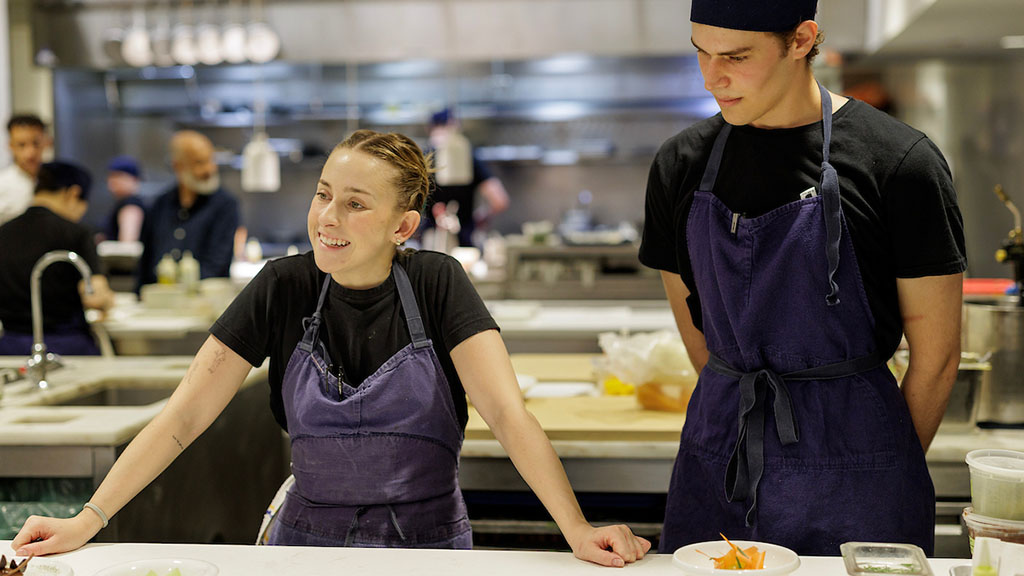
Brecher witnessed his growth over the summer weeks. “When he started, he hadn’t worked a service in pastry and our lunch service is our most difficult in the building,” she says. “We’re doing the tickets, expediting to the servers, communicating where the plates need to go. There’s a lot of steps and you have to be doing everything very quickly, but very precisely, so it’s a hard blend of skills. It was definitely a huge task to leap into, but Daron found a way to organize his brain and get things done. His plating has come a really long way and he’s learned new techniques. He’s become a very reliable and strong service cook.”
Despite the challenges, or maybe because of them, Sklar says working at The Modern was an unmatched learning experience, “that gave me so much inspiration to pull from.”
With up to nine desserts in rotation on any given day, each with half a dozen or more components, Sklar says he learned a lot about plating techniques and came away with new ideas and fresh perspectives on combining ingredients.
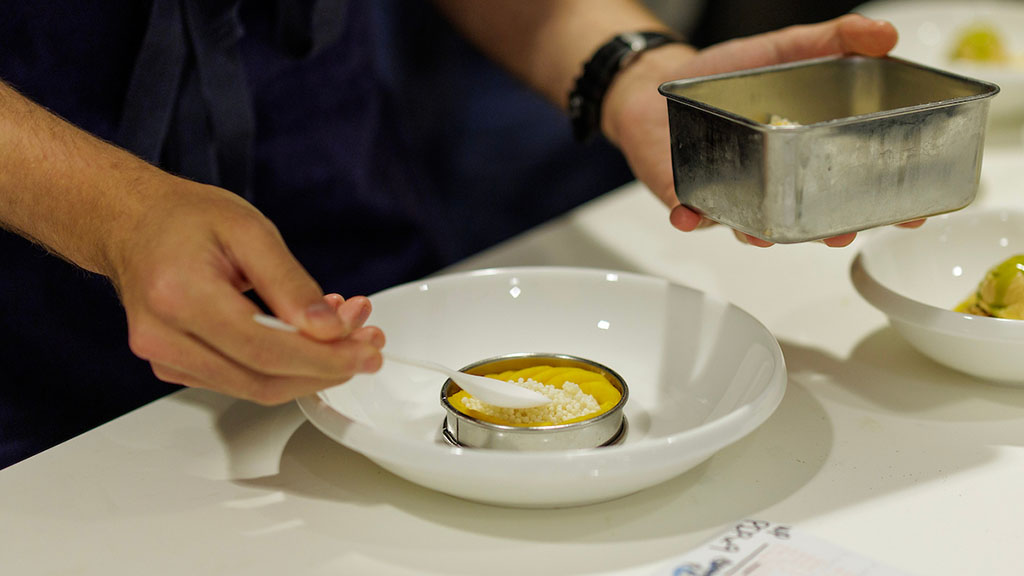
He particularly enjoyed plating an intricate banana dessert with devil’s food cake, cacao nib crunch, banana caramel, coffee ice cream, banana sabayon, banana chips, chocolate tuile and cacao nib crumble. The most difficult to plate, he recalls, was a dessert featuring mint caramel, chocolate crumble, creme fraiche, dark chocolate ganache and shiso ice cream.
While Sklar’s short-term goals are to continue to work in fine dining, he ultimately plans to work as a research chef in the area of food science. “I’m in the culinary science and product development program with a baking and pastry focus,” he says, “So my goal is to build up my pastry skill set and then apply that to large-scale packaged goods production.”
Brecher hopes Sklar is the first of many JWU students and grads she can bring on board at The Modern. “You can really tell the difference between a JWU student and students from elsewhere, just based on passion alone,” she says. “They’re leaders in the kitchen because of the energy and the excitement they bring, and you need those people because that motivates everyone else in the kitchen to match it.”