Culinary
Alumni
Hospitality & Business
Culinary
Plating Up Nutrition Empowerment in Charlotte
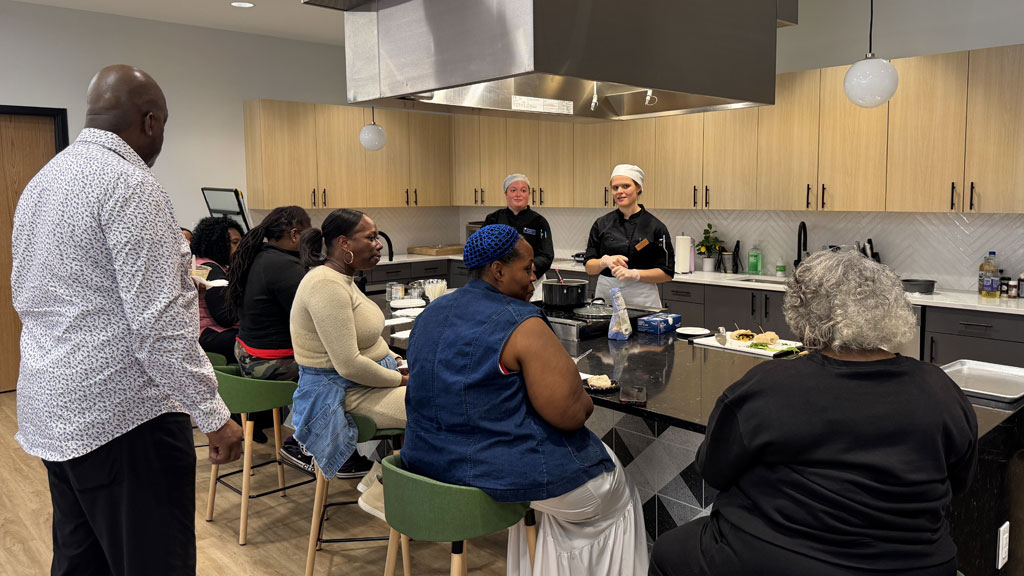
This spring, JWU Charlotte culinary nutrition students put their expertise into practice by leading Pantry to Plate classes at Nourish Up, the largest food pantry in North Carolina.
Classes are small — typically 15 participants or fewer — which encourages sharing, collaborating and connecting. Assistant Professor Leslie van Horn, DCN, RDN, LDN, FAND, works with the students to make sure that they map their dishes to simple, demonstrable lessons. As she explained, “When planning our Pantry to Plate menus, we often build meals around vegetables, a whole grain, and a protein, which helps create a balanced plate in a way that feels practical and approachable for home cooks.”
Making Nutritious Eating More Accessible
For each class, students demonstrate three recipes and lead a nutrition discussion to help community members build their kitchen confidence for making budget-conscious healthy meals in their own homes. Noted van Horn, “Not only is this wonderful experiential learning, but it allows our students to make an impact in our community through culinary and nutrition education — making nutritious eating more accessible to underserved groups.”
“People don’t need perfect diets — they need realistic ideas, confidence and simple skills.”
For a recent class, JWU Charlotte nutrition students Amalee Barrett ’27 and Peyton Parker ’27 centered their dishes around healthy fats, fiber and nutrient-dense ingredients, like carrots and Brussels sprouts. They made the following:
- Pan-seared chicken: Lean protein that supports muscle health and keeps you full.
- Succotash with brown rice: Brown rice adds whole-grain fiber and complex carbohydrates, while the corn, lima beans, and bell peppers contribute vitamins, minerals and antioxidants.
- Roasted Brussels sprouts: High in vitamins C and K, fiber and antioxidants to support immunity and heart health.
- Carrot cake: Provides beta-carotene (vitamin A); nuts add healthy fats and protein.
Both Barrett and Parker acknowledge that teaching a community nutrition class is far more complex than just telling their audience how to eat superfoods every meal. As Barrett explained, “People don’t need perfect diets — they need realistic ideas, confidence and simple skills.”
Emphasizing Realistic Strategies & Dietary Balance
As community advocates, both JWU students take their role as stewards very seriously. “Many people are overwhelmed by nutrition information online, fad diets and conflicting messages,” explained Barrett. “As a nutrition educator, my role is to … respect budgets and food access, provide realistic strategies, and encourage small changes instead of perfection.” That is one reason the duo decided to conclude their demo with carrot cake. “Desserts can still have nutrients and fit into a balanced diet,” she noted.
Putting community members at ease is crucial for building their trust. Prior to class, van Horn advises her students to have a clear framework for how they want to structure their demo, rather than working from a script: “The most effective sessions tend to feel conversational and approachable, almost like teaching a friend. That mindset can help ease some of the nerves, make the experience feel more natural and create stronger connections with participants.”
Taking van Horn’s message to heart, Barrett and Parker refined their presentation to simplify the information and to focus on nutritional balance, rather than restriction. As Parker put it, “Demonstrating small, achievable steps empowers individuals to make healthier choices independently.”
In addition to offering tips on building kitchen confidence, they offered practical ways to stretch weekly groceries and reduce food waste.
Barrett’s favorite maxim is “Cook once, use twice”: “Plan meals so leftovers become part of another meal.”
Parker encouraged participants to save veggie scraps for repurposing into broth: “Even slightly wilted greens or carrot tops can contribute to a delicious homemade stock.”
In her pre-class coaching, van Horn emphasized the importance of convenient staples like frozen fruits and vegetables, boxed whole grains or tofu, and canned goods like beans, tomatoes and low-sodium broth: “These items are affordable, shelf-stable or long-lasting, and make it much easier to put together a quick, balanced meal.”
At the conclusion of their most recent class, Barrett and Parker were gratified by participants showing their enthusiasm for what they’d learned. One shared plans for roasting vegetables with simple seasonings and a quick marinade (an excellent way to increase flavor); another talked about adding beans to an existing dish to boost protein and fiber.
Other takeaways from their class:
- That frozen vegetables are just as healthy as fresh and often cheaper.
- Realizing that fiber helps with energy and digestion, not just “being healthy.”
- How simple swaps like whole grains, Greek yogurt, or adding beans can improve a meal.
“One of the best moments was when someone said they were going to try making one of the recipes at home for their family. That showed that the class wasn’t just informative, but it was practical and useful,” said Barrett. Parker added, “Moments like these where someone has an ‘a-ha!’ about how nutrition can fit into their everyday routine are incredibly rewarding.”
During class sessions, Van Horn and Chasidie Glover, who leads the Pantry to Plate program, are always on hand in case participants ask complex nutrition questions. (Both are registered dietitians.)
As the program nears its one-year anniversary, van Horn noted that 100% of participants have reported learning a new way to prepare a vegetable, while participants who were not “extremely confident” in preparing the featured ingredients before the class reported increased confidence by the end of the session. For the student teachers, the sessions have been eye-opening and empowering. “[I’ve learned] that nutrition education is most effective when it is practical, positive and focused on small changes that people can realistically maintain,” said Barrett.
“One of the best moments was when someone said they were going to try making one of the recipes at home for their family. That showed that the class wasn’t just informative, but it was practical and useful.”
Recipes, Demos & Heart-Healthy Snacks
Springtime is always busy for community outreach events. JWU Charlotte students have been active at multiple events, including:
- Community Nutrition students developed seasonal recipes to share at weekly installments of the Bulb’s free mobile markets across the greater Charlotte area. On the last day of class, the students recorded live demos of their recipes with the Bulb’s Elsa Carrillo for posting on the organization’s website and for replay at select markets.
- Food & Beverage Entrepreneurship major Jose Rodriguez-Valdez (who is minoring in nutrition) gave a bilingual demonstration of a spring-inspired fruit tostada for a Camino Salud daycare group.
- Lastly, Culinary Nutrition major Alenys Borras demonstrated heart-healthy snacks at the Heart Strong: Reggie Bell Health Fair. She showed how to prepare garlic hummus, veggie hummus wraps and nut-free granola recipes.
Related Posts

Culinary
Students
Johannah Evans Brings Passion to Scholarship Event
Hospitality & Business
Culinary
Experiential Education
Inside the Masters: Gaining Hands-On Experience at Augusta National
Health & Wellness
Culinary