Students
Health & Wellness
Students
White Coats Mark Physician Assistant Students’ Next Step
Johnson & Wales University’s Master of Science in Physician Assistant Studies (MSPAS) Class of 2027 marked a major milestone this month: completing classroom study and entering a year on hands-on clinical fieldwork.
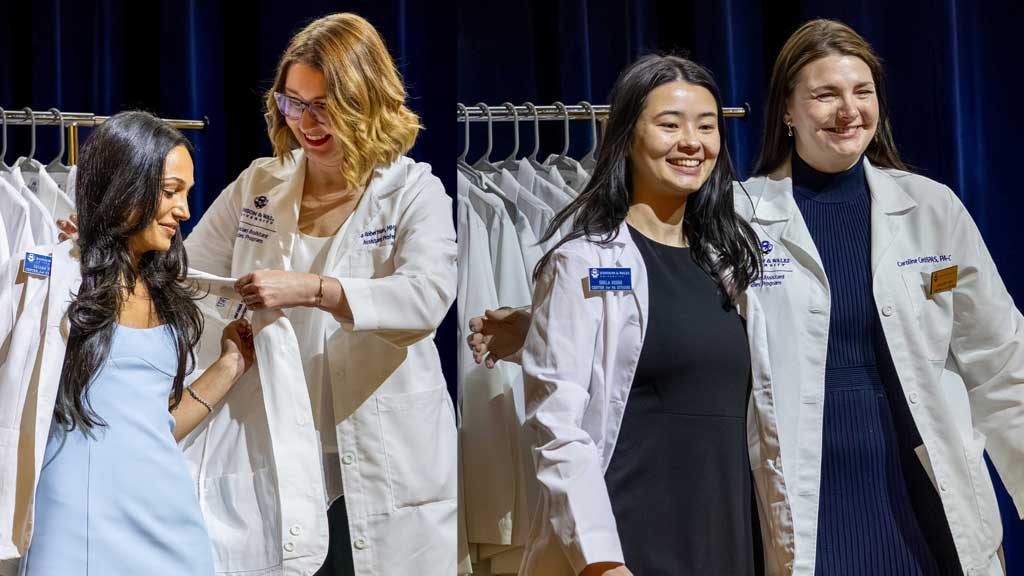
At the program’s 12th annual Physician Assistant (PA) White Coat Ceremony, 35 MSPAS candidates recited the Physician Assistant Professional Oath, which begins, “I will hold as my primary responsibility the health, safety, welfare and dignity of all human beings….”
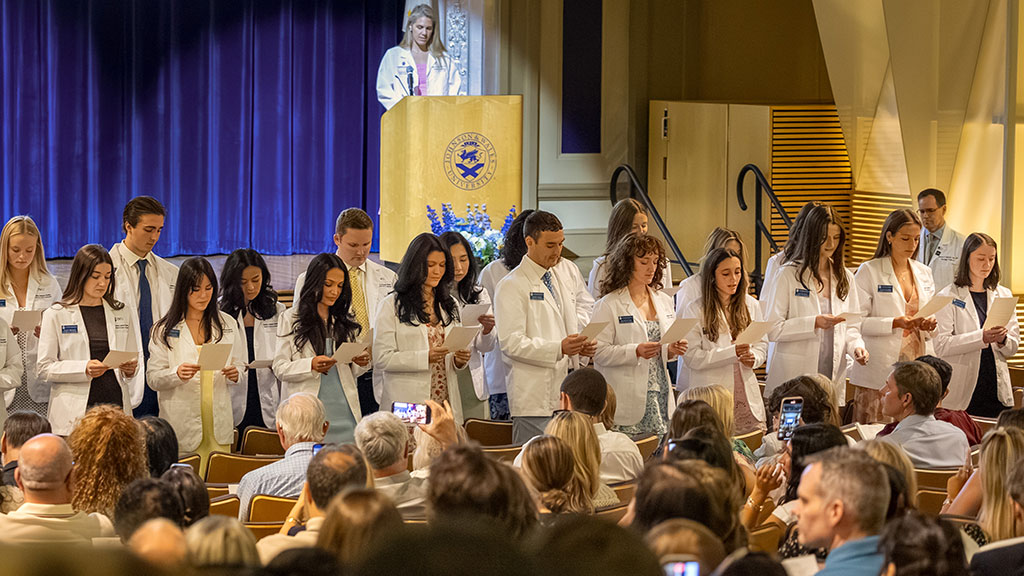
For the next year, the cohort will work full time under preceptors at clinics and hospitals, immersing in various specializations, before graduating next May.
The ceremony, attended by faculty, family, friends, preceptors and the Class of 2028, celebrated the cohort’s transition from classroom to clinic while recognizing what mattered most: people.
Why JWU’s Physician Assistant Program Is Best in Rhode Island
“I remember our novel cohort 12 years ago and the excitement surrounding our launching the first PA program in Rhode Island,” noted Thomas Meehan, Ph.D., PA-C, director of the Center for Physician Assistant Studies. “Today, JWU has one of the best PA programs in the region. We’ve graduated over 350 PAs with a 96% graduation rate, a 97% first-attempt Physician Assistant National Certifying Examination® (PANCE) pass rate and an overall 100% PANCE pass rate. We have a strong reputation, thanks to our students and to the faculty and staff who bring out the best in them.”
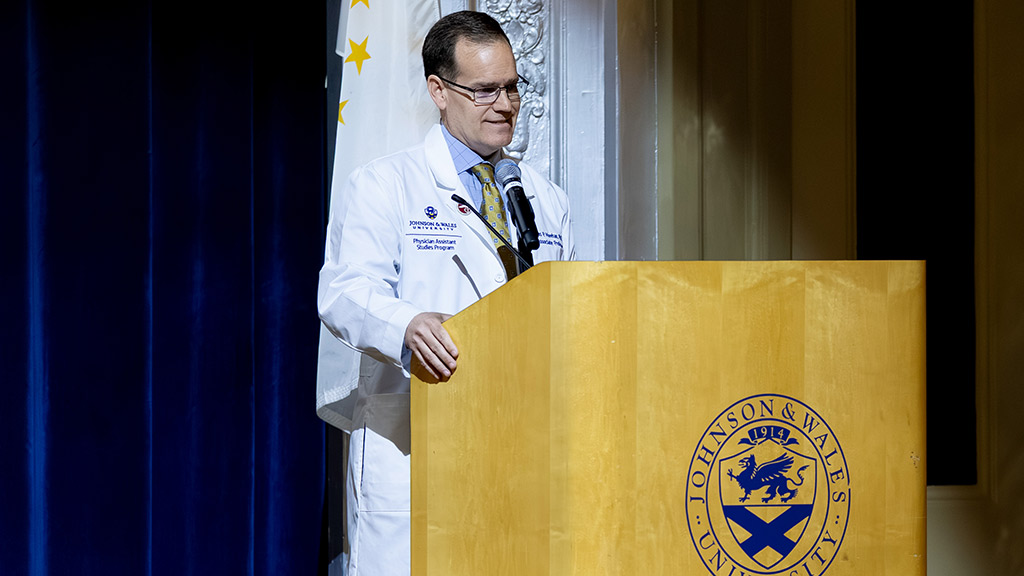
Meehan praised the Class of 2027 students’ interest in their communities.
“I know we’ll be in great hands,” he affirmed. “You’re not just healers, but changemakers. Last night, thanks in part to the advocacy of JWU’s faculty and students, the Medical Primary Care Scholarship Program bill passed in the Rhode Island Senate. Through this bill, five PA students would receive up to $47K per academic year in scholarship aid.”
The bill is now in the House, and Meehan encouraged Rhode Island residents to reach out to their representatives to support it.
The Importance of Being a Physician Assistant
“The white coat is a symbolic representation to your commitment to compassionate care, humanism and the ethical responsibilities of the medical profession,” George S. Bottomley, DVM, PA-C, former PA director at Yale University and founding dean of JWU’s College of Health & Wellness, told the Class of 2027. “It’s a moment to reflect on why you wanted to be a PA, why you’re here in this program, and how you’ve learned and grown in so many ways during your didactic year. It gives a moment to celebrate the love and support from your family, friends, mentors and faculty.”
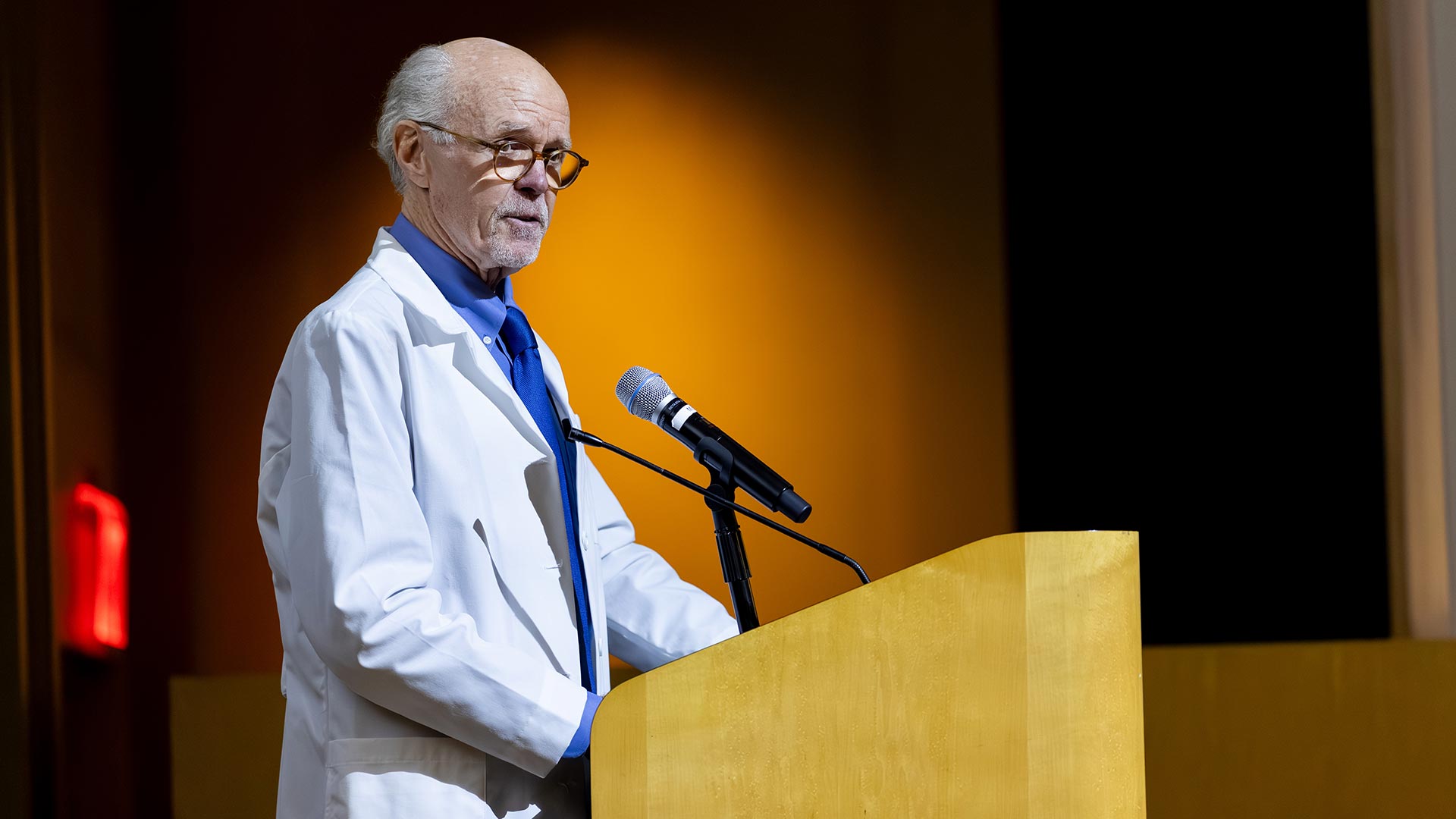
Fourteen years ago, as Bottomley interviewed students for JWU’s first PA class, things looked a bit different: “We only had architectural drawings of what the Center for Physician Assistant Studies building would become, perched on easels overlooking a gutted jewelry manufacturing building.”
That building became an award-winning, 18,000-square-foot center for learning, celebrated with an opening ceremony in 2014 that included then-Governor Lincoln Chafee and leaders from the Warren Alpert Medical School of Brown University and the Rhode Island Free Clinic.
“Humanism is explicitly used in the PA mission statement at JWU,” Bottomley stated. “It’s painted right on the wall so we can all understand the foundational belief our program is built on: having respect, empathy and trust in humanistic healthcare. As you’ve learned and will apply in your clinical year of medicine, being a PA is about more than keeping human biological mechanisms functioning. A good practitioner treats disease, but a great practitioner treats the patient who has the disease. It’s a calling, not a business.”
His advice to the Class of 2027: “You’ll face challenges and be tested, but I believe it will be the experience of a lifetime for you. I was formerly a veterinarian, and when I’m asked what qualities I want in a PA student, I respond, ‘The human equivalent of lab retriever, smart and kind.’ Go out and let your inner lab retriever shine. Be smart and kind, and you’ll be fine.”
What It’s Like Being in JWU’s Physician Assistant Studies Program
Student speaker Katherine “Katie” Mayhew ’27 MSPAS noted that the PA program is challenging — but the people make it all worthwhile.
“Studying to be a PA is like being handed a new 1,000-piece puzzle every week,” she explained. “By the time you’ve figured it out, you’ve been given a new one, and the old ones never go away. But I also found a group of truly remarkable people. My cohort members aren’t the loudest in room, but they’re the loudest in compassion, in work ethic, in how they show up for each other and in how they care.”
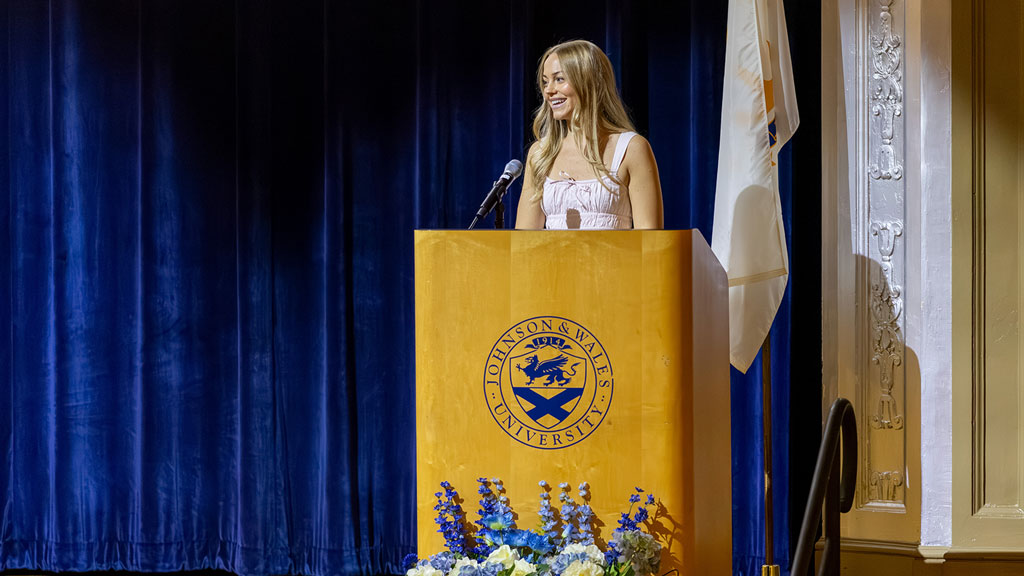
“Underneath is all, we loved the puzzle,” Mayhew stated. “We loved medicine, loved learning and above all loved caring for patients. We learned how to be flexible and adaptable under pressure and keep moving.”
“To the faculty: thank you for teaching, challenging and encouraging us, giving us space to make mistakes, grow and slowly believe we can do this,” she expressed. “To the incoming class: have faith, you’re in great hands. To family and friends: thank you for feeding us, listening to us complain, letting us use a scope to find your optic nerve and understanding our chaotic schedules.”
“Today isn’t about pretending we know everything but about recognizing how much we’ve grown and how ready we are to continue learning,” Mayhew said. “We have so much more knowledge and confidence than a year ago, and we’re ready to enter medicine. I’m so proud of my classmates and so lucky to know you all. All of this has allowed us to do what we’re here to do: take care of patients.”
Message from the PA Program Director
“From your initial ‘aha’ moment about becoming a PA to the application process, we celebrated you along the way,” Meehan told the cohort. “This has been the toughest year of your PA education journey; next year is the fun part. You’ll continue developing clinical skills in patient care.”
“Taking care of real patients is what students come to our school to do,” Meehan stated. “Outside the classroom, I encourage you to continue giving back to the community, organizing events and setting the bar high for future cohorts by becoming collaborative practitioners who practice with empathy and trust. I know you’ll go out to your rotations carrying on this mission every day.”
“To the newly coated class: treat every patient with kindness and empathy,” he advised. “Remember what your faculty taught you: be humanistic, empathetic providers. Have a relaxing weekend, because Monday is the first day of your careers.”
Related Posts


Students
News
Visiting Campus? Plan a Perfect R.I. Weekend
Culinary
Students