News
Arts & Sciences
Health & Wellness
Experiential Education
Health & Wellness
Arts & Sciences
JWU Students Explore Hippotherapy Through Hands-On Trip
Hippotherapy is a specialized type of therapy that uses a horse’s movement to help treat patients with physical, occupational or speech challenges. (It does not involve hippopotamuses, which was news for this writer.) This spring, students in theAnimal Science, Health Science, and Exercise and Sports Science programs experienced this unique type of therapy firsthand on a trip to the The Bridge Center in Massachusetts.
The Bridge Center has a 22-acre campus featuring an equestrian center with hippotherapy programming and other therapeutic services for children and adults with disabilities. Many of the JWU students who attended the trip are preparing to continue their studies in our Occupational Therapy Doctorate (OTD) or Doctor of Physical Therapy (DPT) programs, so the opportunity to learn about the different types of therapy available to patients and put it into practice was a valuable lesson for their future careers. “Students engaged with trained clinicians in hippotherapy,” says Assistant Professor Travis Gagen, Ph.D., who helped organize the trip. “We got to meet the horses, learn about the anatomy and healthcare of the horse, tour the facility and meet the goats at the location.”
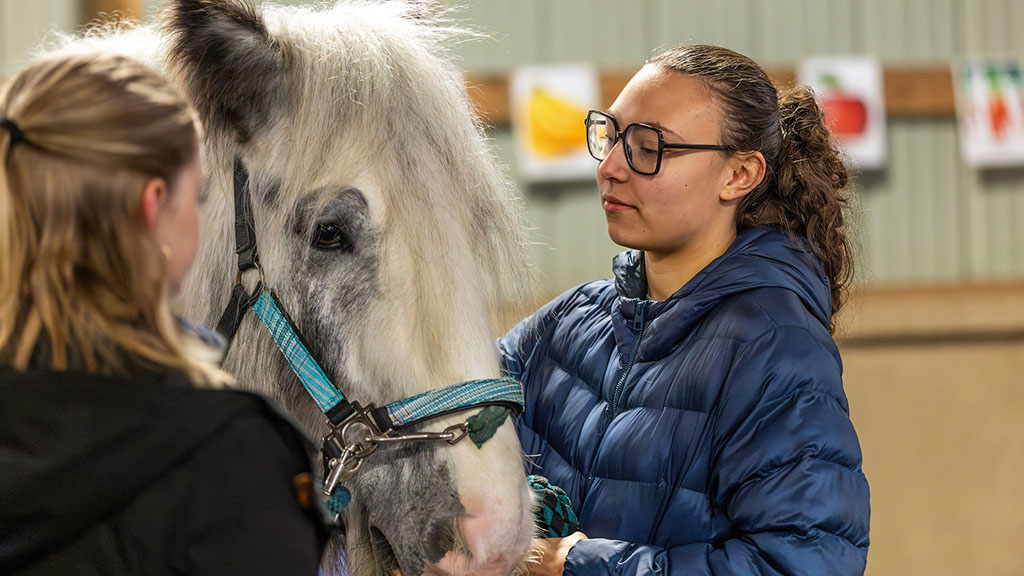
Along with Gagen and his College of Health & Wellness students, Assistant Professor Chris Holland, Ph.D., and Animal Science students were also invited on the trip, making it an interdisciplinary collaboration with the College of Arts & Sciences. The combination of different majors allowed Animal Science students to share their expertise in caring for and handling animals while health students shared their knowledge of working with human patients. It was a unique setting for them to apply their respective skills, but one that required them to work together.
“I was excited to collaborate with the Animal Science program since I often don’t get overlap with them,” says Simon Nichols ’29, a Health Science major who is planning to enter the OTD combined degree pathway. “I wanted to go on the trip because I have experience with horses but had never heard of them being used for occupational therapy — I was interested and excited to learn about the intersection between the two.”
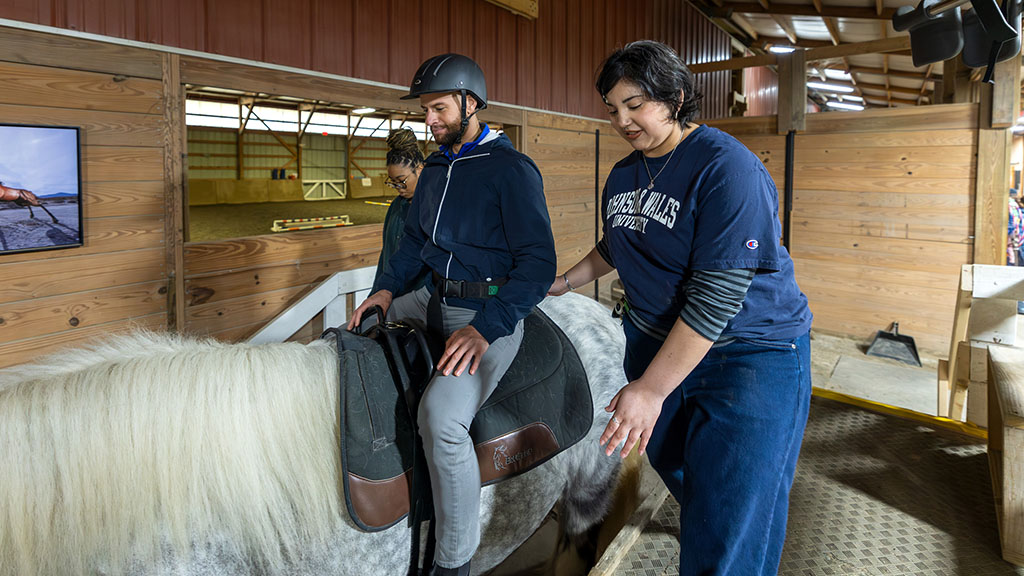
For Animal Science student Leaha Bell ’27, it was also exciting to work with students outside of her major and put her prior experience with horses to use. “Some of the health students had never been up close with a horse,” says Bell. “That was my second time going to The Bridge Center, so with me somewhat knowing what I’m doing with horses, I was able to bounce things off of the other students.”
After their tour of the facility, students were split into three groups that rotated between three different activities. “The first activity I did was fitting Professor Holland with a gait belt and helmet and observing as the staff demonstrated all the ways a person can sit on a horse and why they may place an individual that way,” Nichols explains. “For example, sitting sideways on a horse forces you to use one side more than the other to remain upright— this would be useful for someone with left- or right-sided weakness.”
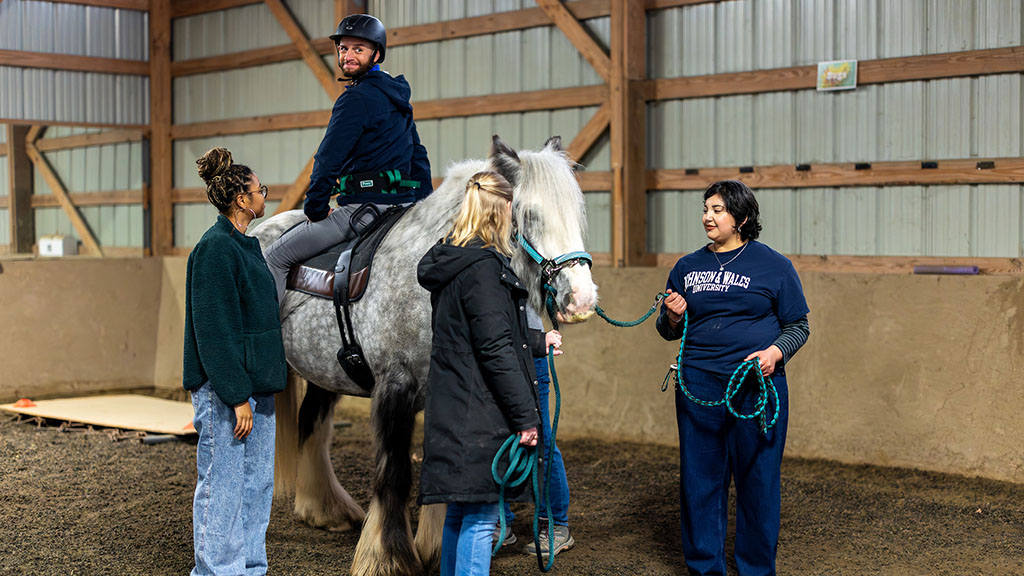
“It was a hands-on experience where we were able to act as one of the physical/occupational therapists to guide him and see the different types of positioning and how they can help different parts of someone’s body,” adds Camila Leiva ’29, an Exercise and Sports Science major who hopes to become a physical therapist through JWU’s Doctor of Physical Therapy (DPT) program.
The second activity involved analyzing data from a biometric monitor on a horse that had just completed a workout to assess its fitness and ability to perform tasks. “There’s a small device that goes around their tail and it tracks their heart rate and other metrics,” explains Bell. “They had an app that goes with it, and we played around with that to see how much weight the horse can carry or how much work they can be put through and not be overworked. It really focuses on the husbandry of the animal, which is also an important part of our studies in the Animal Science program.”
“The final activity involved standing behind a horse and using long reins to guide it around the track,” Nichols says. “This was used to demonstrate that the horse doesn't need to be ridden to be used effectively for treatment.”
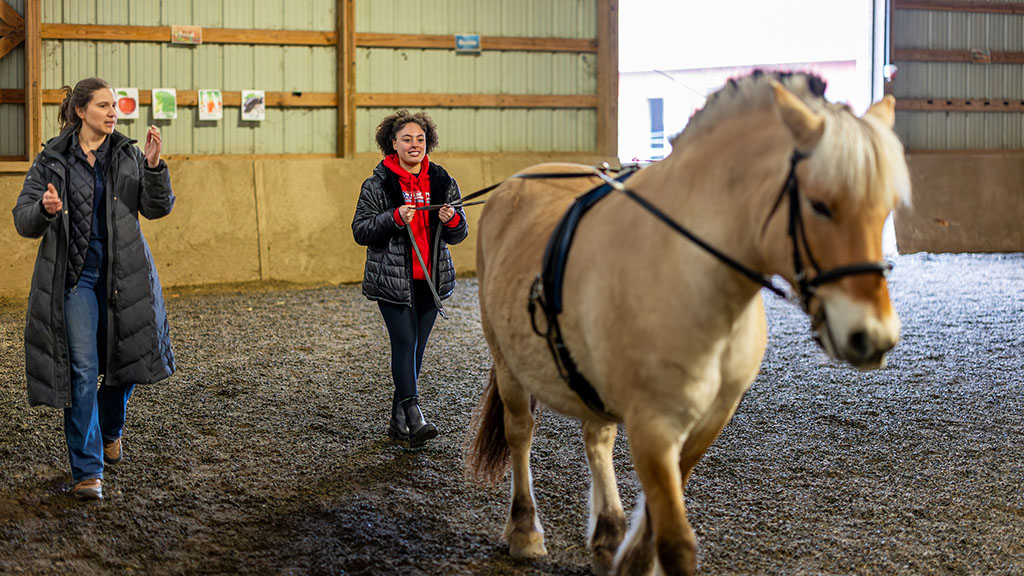
After the groups cycled through the three activities, they were assigned a mock patient case study to create a treatment plan. “We were each assigned a person with a description of their age, conditions and preferences,” says Leiva. “With the given information, we had to assess what kind of horse to assign them to, how much stability they needed and what kind of movement we were looking for the horse to have.”
Students left the experience with a new appreciation for hippotherapy, an approach that many had never even thought to consider as a form of patient therapy.
“I learned that horses are a great source of aid if used properly,” says Sofia Mangino ’26, a current Health Science student who was recently accepted into the OTD program to take advantage of the combined pathway. “There are so many different styles of riding horses, gear and horse anatomy that can be used to target specific goals for clients that I have never even considered before.”
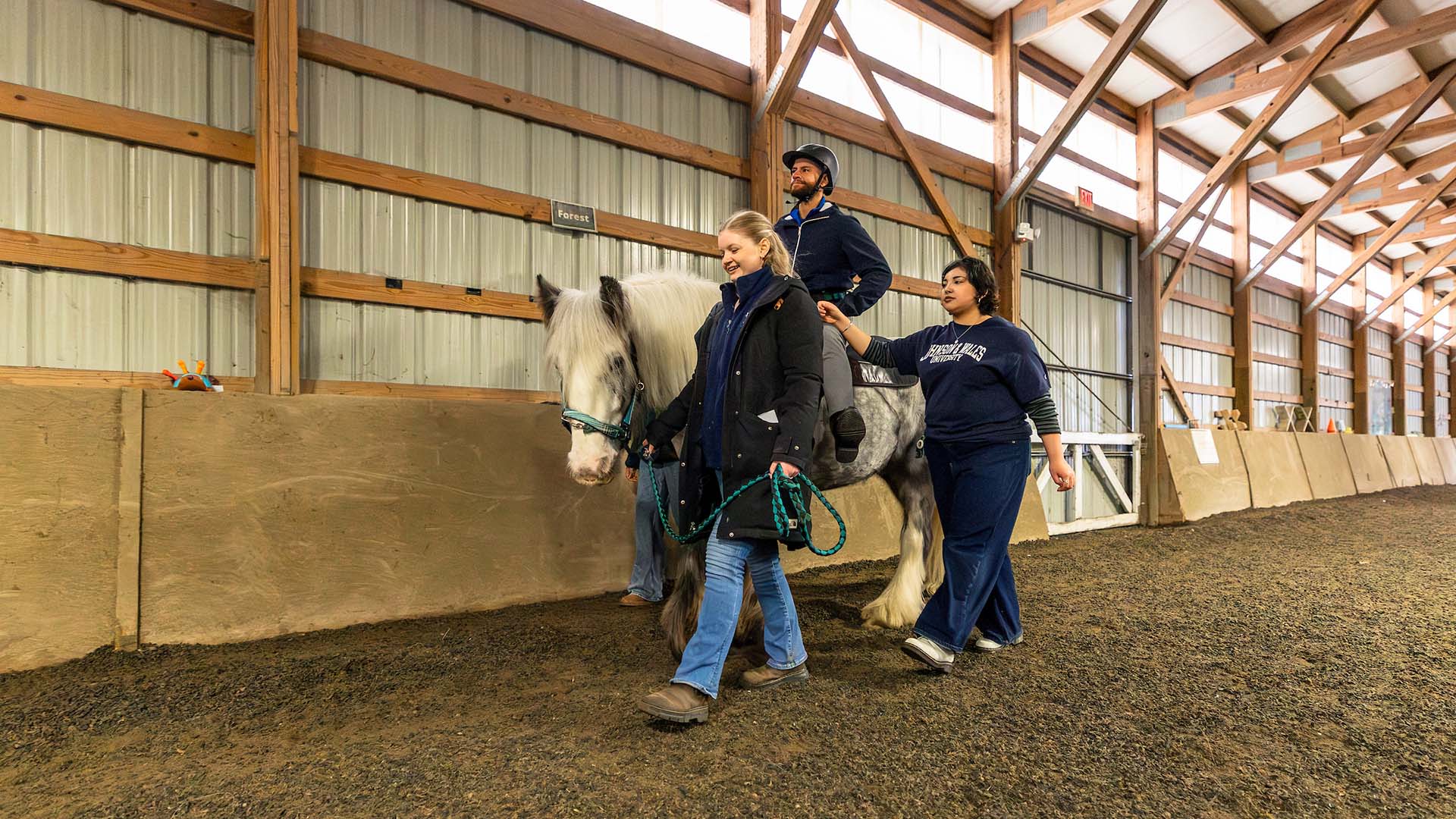
“Going into the activity, I wondered how much it would really be different from regular horse riding, and how it would apply to occupational therapy,” adds Nichols. “I'm so glad I kept an open mind because it allowed me to learn so much more. I think I'll be a better future health professional because of this experience.”
The trip was a prime example of why bringing students from different programs together for an experience is so important. They got to see firsthand how collaboration among different fields can make an impact and how much a unique approach like hippotherapy can be used to treat a variety of disabilities. Both the Animal Science and the health students left with a new perspective on how their fields can work together.
Related Posts
Hospitality & Business
Experiential Education
Students
JWU Hospitality Student Lands Outdoor Adventure Internship
Arts & Sciences
Alumni